
 ChatGPT
 Perplexity
FabCon Europe 2026 covered Fabric, SQL, AI, real-time intelligence, data engineering, governance, application development, and plenty of product announcements.
But across the technical sessions, demos, stage presentations, and conversations in Barcelona, I kept coming back to a different question:
What changes when the data platform stops sitting primarily behind analytics and starts supporting more of the work that follows?
Over the course of the event, those pieces started to connect in a more practical way. Fabric data is becoming easier to use beyond reporting and analysis. Copilot is drawing more governed business context into the flow of work. Real-time and batch workloads are being brought closer together, while Microsoft is also strengthening the observability and controls needed as production dependency on the platform grows.
Fabric is becoming relevant to more parts of the enterprise architecture, going beyond just the analytics layer.
Here are the updates that best capture how Fabric’s role is expanding across applications, architecture, operations, and modernization.
1. Fabric brings data closer to business action
One session captured this particularly well: “From Insight to Action – Translytical Taskflows and AI in Microsoft Fabric.”
For years, the natural endpoint of a data platform was often a report, dashboard, or model that informed somebody elsewhere. Barcelona showed more clearly what that direction means once these capabilities start coming together.
Across Power BI, Fabric Apps, Copilot, and Real-Time Intelligence, the same direction kept showing up: Microsoft is reducing the distance between governed data and the applications or workflows that act on it.
What stood out was how thinner the boundary between the data platform and its consumers is becoming.
As Fabric becomes more embedded in operational work, engineering quality starts to matter in different ways. A stale number on a dashboard and a stale signal driving an operational workflow do not carry the same risk. Neither do an incorrect business definition in an analysis, and the same definition being reused by an agent taking action.
We are seeing the same shift across the Fabric programs we work on. The architecture discussion increasingly extends beyond how data lands in the platform to which applications, AI workloads, and operational processes can safely depend on it once it gets there.
2. Unified platform creates more architecture choices
Some of the deeper technical sessions and conversations we had at Barcelona made a useful counterpoint to all the convergence.
OneLake shortcuts, mirroring, IQ sharing, and interoperability give teams more ways to work across data estates without assuming every new consumer needs another physical copy.
More flexibility does not make the architecture decision any easier. There are still good reasons to materialize data for performance, workload isolation, sovereignty, resilience, or transformation.
Latency is another place where capability and need can easily get confused. There were examples involving Event streams, telemetry, streaming workloads, and lower-latency decision paths. But a finance process may work perfectly well on yesterday’s close, while fraud detection may have seconds.
The right latency is determined by the decision window, not by what the platform can technically deliver. In our Fabric work, platform capability is rarely the deciding factor at this point. The harder choices are whether the workload justifies another copy, lower latency, tighter isolation, or a different execution pattern altogether.
So the useful question is not: Can Fabric do this?
It is: Should this workload be engineered this way?
3. Shared business context makes data more reusable
The AI discussions in Barcelona made one thing clearer: Microsoft is trying to make business context reusable across more of the experiences built on that data.
Fabric IQ is part of that move, carrying governed metrics, relationships, definitions, and domain context into experiences such as Power BI, Copilot, applications, and agents rather than leaving each one to reconstruct that meaning independently.
A shared data foundation is only useful if the same customer, contract, margin, or operating rule is interpreted consistently wherever it is consumed. Otherwise, the fragmentation simply shifts from the data layer to the experience layer.
It also raises the bar for what “AI-ready data” means. Access is only part of the requirement; the context, definitions, ownership, and relationships around that data need to be reusable as well.
4. Operational control grows with shared workloads
Copilot and agent development naturally attracted attention in Barcelona.
Anyone responsible for keeping a large Fabric estate healthy in production would have spent just as much time on observability, monitoring, Database Hub, deployment controls, and the operations side of the platform.
Their importance becomes clearer once applications and teams outside the data function begin relying on Fabric. Once that happens, failures stop staying neatly contained. A pipeline issue can surface in an application, capacity pressure can ripple into user-facing workloads, and even a semantic or deployment change can affect several downstream experiences at once.
At that scale, getting Fabric live is no longer the difficult part; keeping shared workloads reliable is. In Simform’s engagements, the work moves into isolation, testing changes before they propagate, capacity and performance monitoring, and clear ownership when something breaks.
Consolidating the platform may remove some of the plumbing, but the operational responsibilities remain and become more visible once multiple teams depend on the same environment.
5. Modernization prepares the foundation for what follows
As Fabric starts supporting more than analytics, the migration target changes with it. If the same foundation will eventually support applications, Copilot, agents, and operational workflows, moving legacy data into Fabric is only part of the job. Poor-quality data, weak governance, and incomplete context do not disappear with the move. They become dependencies for whatever gets built next.
And the closer those workloads sit to the same foundation, the less room there is for weak engineering to stay contained. A data-quality issue that once affected a report can eventually surface in an application, an AI response, or an operational workflow.
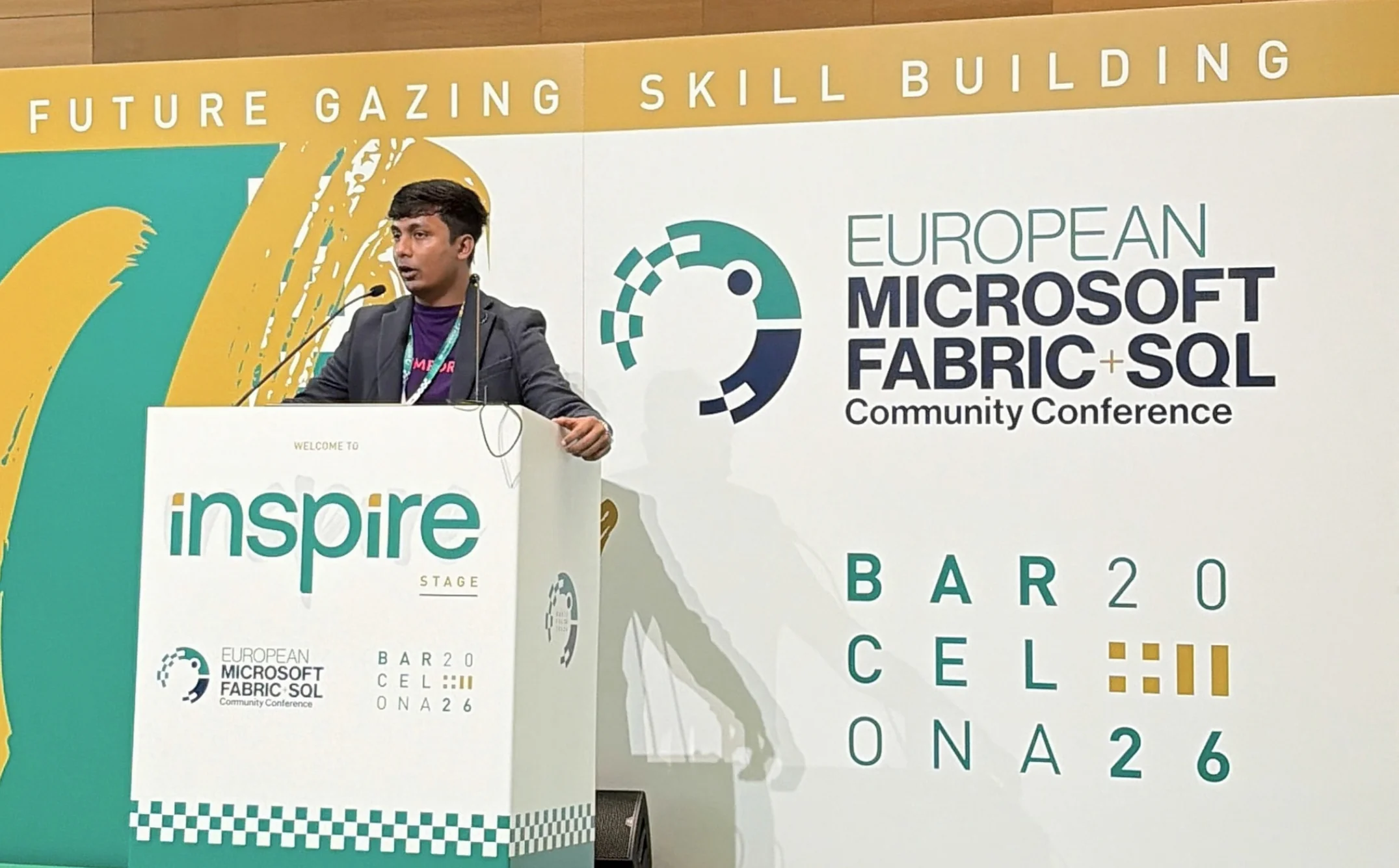
Our Inspire-stage session at FabCon Europe approached modernization from that angle: how do you move a legacy estate into Fabric without carrying those problems forward?
Using TrueMorph, we demonstrated migration alongside data-quality checks, anomaly detection, suggested remediation, and human approval before changes progressed further through the platform. The workflow also handled PII and PHI before downstream use and assessed AI readiness across dozens of parameters rather than treating migrated data as automatically ready for AI workloads. The demo treated migration as an opportunity to improve the condition of the estate as it moves.
The real measure of modernization is whether the resulting foundation is engineered well enough for what the enterprise plans to build on top of it.
6. Fabric supports more of the enterprise stack
At FabCon US, the direction was already taking shape: data unification, semantic intelligence, real-time workloads, AI readiness, and agentic systems increasingly converging around Fabric. These previously separate threads became part of the same architecture conversation at Barcelona.
The same foundation can now serve a broader set of workloads, carry more business context, support different latency models, and sit closer to applications and workflows.
For me, the question is shifting from: How do we bring our data estate together?
To: What are we prepared to let depend on it once we do?
That second question forces architecture, data quality, semantics, observability, security, capacity, application design, and ownership into the same conversation.
It also gets closer to how we think about Fabric modernization at Simform. The objective is to leave behind a foundation that the next analytics workload, application, AI experience, or operational process can depend on without creating another round of fragmentation or rework.
That, more than any individual announcement, is what I took away from FabCon Europe 2026.