

 ChatGPT
 Perplexity
Startups don’t struggle with building features. They struggle with how quickly those features can evolve without creating operational drag.
Serverless has changed that by taking infrastructure decisions out of the critical path. Adoption has also accelerated in recent years. The serverless computing market is projected to reach over $25 billion in 2025, growing steadily as more teams move toward event-driven and scalable architectures.
This shift reflects a deeper change. The advantage is no longer limited to faster deployment. It is about how systems handle unpredictable workloads, user-driven events, and continuous product changes without increasing operational overhead.
For startups building on platforms like Azure, serverless is less about removing servers and more about designing systems that scale with product complexity without requiring a proportional increase in engineering effort.
Evolution of Serverless Technology
“Serverless” was first mentioned in a piece written by Ken Fromm in 2012. The road to the evolution of serverless started back in the 1990s and not in 2012. Software development back in the ’90s saw organizations separating frontend and backend. It was great for development purposes, but firms were paying for an idle resource that could not scale down according to the traffic.
Problems of scaling on-demand computing resources were first addressed through the introduction of VMs in the 2000s. Although, the actual evolution of computing resources began after introducing EC2, S3, and SQS.
While early momentum came from AWS Lambda, the evolution has matured significantly with platforms like Azure Functions, Azure Event Grid, and Azure Logic Apps, enabling startups to build systems that react to events across applications, data pipelines, and external services.
Today, serverless is no longer limited to backend logic. It extends into:
- Real-time data processing
- AI-triggered workflows
- Event-driven microservices
- Integration across SaaS ecosystems
According to Martin Fowler, there are two overlapping areas which serverless encompasses,
- Serverless was first used as a concept that describes the application with integrated third-party services and cloud-hosted apps which manage server-side logic. Such services are often described as the “(Mobile) Backend as a Service” or BaaS.
- Serverless can also be described as an architecture where server-side logic is written from scratch and is run in stateless compute containers that are event-triggered and fully managed by third-party services. It is often referred to as “Functions as a Service” or “FaaS”.
BaaS and FaaS offer a similar attribute of no need for resource management, but they are different in their approach. Backend-as-a-Service (BaaS) is a serverless architecture where the service provider manages all behind-the-scenes aspects of web or mobile apps. BaaS vendors offer pre-written software that automatically manages user authentication, database management, remote upgrading, and even cloud hosting.
Platforms like Azure provide managed services where much of the application logic is handled by the platform itself. This reduces the need to build and maintain standard backend components.
FaaS also allows you to write codes but rather than completely outsourcing the backend, it offers a modular approach. So, you can write and update a piece of code on the fly in response to an event like a user clicking on the download button in a web application. FaaS makes it easy for you to implement code and scale it through the execution of microservices.
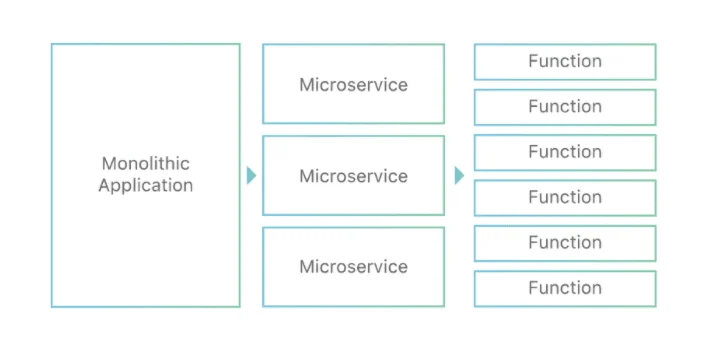
In a monolithic architecture, the entire code is interconnected in the form of one large system, which creates a hefty deployment process each time you want to update a function or a feature. On the other hand, FaaS leverages the microservice architecture-based approach. Since functions are independent, developers can work on individual components without affecting the entire system, providing a higher turnaround time in the long run.
With services like Azure Functions, developers write discrete units of logic that run when triggered by actions such as API calls, data updates, or message queues.
Most modern applications use a combination of both. BaaS handles standardized backend needs, while FaaS is used where product-specific logic or event-driven behavior is required
Pros and Cons of Serverless Architecture
Choosing serverless architecture for your startup is a business decision and takes more than just one advantage. There is no doubt that serverless does offer a hassle-free development facility and enables quicker development with BaaS and FaaS. But, is that all? Or are there more perks of choosing serverless?
Serverless is no longer just a developer convenience. It is becoming a core architectural layer for event-driven systems.
Some of the core benefits of serverless architecture include:
1) From APIs to events
Modern systems are no longer request-driven. They are event-driven.
Azure Event Grid and Service Bus now act as the backbone for decoupled systems.
2) From functions to workflows
Single functions are rarely useful in isolation.
Startups increasingly rely on Azure Durable Functions and Logic Apps to orchestrate multi-step processes.
3) From cost savings to cost control
Serverless reduces idle cost, but introduces execution-based cost variability.
Without visibility, costs can spike quickly under high-frequency triggers.
Where Serverless Actually Helps Startups
Serverless is not universally better. It is better in specific conditions.
1) When iteration speed matters more than infrastructure control
Serverless removes provisioning delays.
Developers ship features without waiting on infra setup.
2) When workloads are unpredictable
Startups rarely have stable traffic patterns.
Azure Functions scale automatically without pre-allocating compute.
3) When systems are event-heavy
Use cases like:
- file uploads
- transaction triggers
- notifications
- IoT signals
fit naturally into event-driven execution.
4) When teams are small
Serverless shifts operational burden away from developers.
This matters when the same team owns product + infra.
Where Serverless Breaks Down
Most early-stage teams overlook this.
Cold starts and latency sensitivity
Not ideal for real-time systems with strict latency requirements.
Execution limits
Long-running processes require orchestration (Durable Functions), not simple functions.
Debugging complexity
Distributed event flows are harder to trace than monoliths.
Cost unpredictability
High-frequency triggers can silently increase costs without proper monitoring.
Which Serverless Platforms are Best Suited for Startups?
Serverless platforms offer complete resource management and features that help in the automation of functions. Many popular platforms have features and tools that can help develop your serverless applications without much hassle.
#1. Azure Functions
Azure Functions is a fully managed serverless compute service that integrates deeply with the Microsoft ecosystem. You can write Azure functions in programming languages like C#, Java, JavaScript, TypeScript, and Python. The platform has inherent scalability and automatically allocates compute resources as per user requests.
Pros:
- Supports stateful applications for enterprise-grade deployments rather than just focussing on the FaaS.
- Default configuration of the Authentication in the platform offers less overhead for organizations.
- Versatility of the functions which allows deployment across App Service (PaaS), Kubernetes, Azure Stack, and IoT Edge
Cons:
- Enterprise Focus of premium and dedicated pricing plans make it expensive for startups. At the same time, low-end plans have restricted features.
- Capping of consumption plans on the premium plans is much restrictive than other platforms in the market.
Best suited for:
- SaaS platforms
- Event-driven applications
- AI-triggered workflows
- Enterprise-bound startups
#2. AWS Lambda
AWS Lambda is a serverless computing platform from Amazon that runs custom code in response to events. It is offered as a part of the Amazon Web Services and extends these services with custom logic. You can also create custom backend services for your business with AWS Lambda. It automatically runs code in response to multiple events like HTTP through Amazon API Gateway, modification of objects in Amazon S3 buckets, and others. It supports programming languages like Python, Node.js, Java, Go, C#, and Ruby. Startups can also leverage AWS Lambda for SaaS(Software-as-a-Service) web platforms and Node.js application development.
Pros:
- Pricing depends on memory provisioning and the number of computing resources used when users interact with the app.
- Resource management is completely taken care of by the platform allowing startups to make changes on the fly.
- Ease of code deployment and management through AWS custom editor, Eclipse IDE, Visual Studio IDE, and AWS Command-line interface.
- AWS ecosystem advantage with different service integrations and ease of using Lambda function with them.
- Integration with AWS API gateway helps in connecting the function with API and process HTTP requests.
Cons:
- Ability to execute complex functions makes developers forget about the code readability and create a monolith function on AWS Lambda.
- Automation of function by the platform does not offer higher customizations for product owners.
Where it works well:
- Startups already operating within AWS
- Applications that rely heavily on AWS-native services
- Event-driven workloads with high scalability requirements
#3. Google Cloud Functions
Google Cloud Function(GCF) is a serverless platform that helps in building event-based microservices. It offers a pay-as-you-go FaaS to run your code with no need for server management from Google.
GCF can be written using different programming languages like Javascript, Python3, Go, or Java runtimes. You can run your functions in any Node.Js, Python, or Go environment, making it portable and enabling quicker local testing.
GCF can be divided into two types,
- HTTP Functions: It can be triggered by calling the HTTP URL assigned for a specific function.
- Background Functions: External events or cloud services trigger background Function. For example, adding or deleting an image file into your cloud storage triggers the background function.
Google Cloud Functions can react to the events published on other cloud services or third-party services, making it an excellent choice for startups looking to leverage the hybrid cloud.
Pros:
- GCF’s discounted price is lower than other platforms, along with the compatibility of free tools like Firebase and Filestore.
- Instant updates are offered due to the capabilities of Google’s FIrebase that alerts on every update in real-time.
- GCF is built on Knative, an underlying model for Google’s runtime that enables more use cases and is not restricted to FaaS.
- Integration with Stackdriver offers monitoring, tracing, and logging tools for app diagnostics.
Cons:
- Limited features than other platforms in the market like AWS Lambda
- Lack of performance indicated by some benchmarks in comparison to other platforms.
Where it works well:
- Data-driven applications using BigQuery, Firebase, or Pub/Sub
- Lightweight microservices and automation workflows
- Teams prioritizing quick setup and minimal configuration
#4. Alibaba Cloud Function Compute
With Alibaba functions, you can simply focus on writing and uploading the code without worrying about resource management. Alibaba Cloud Function Compute includes a free usage tier that allows startups to experiment with serverless workloads before incurring costs. However, pricing and free limits vary by region and usage patterns, so teams should evaluate current pricing based on their expected workload.
Pros:
- Easy to develop trigger functions with pre-built SDK or compute API
- Better compliance with local regulations in China and Asia
- Supports popular development languages like Node.js, Java, Python, PHP
Cons:
- Pricing plans are more expensive than AWS Lambda and lack flexibility.
- Limited APIs offered by the serverless platform make it difficult to integrate external services.
Where it works well:
- Startups targeting China or broader APAC markets
- Applications that need compliance with local data and regulatory requirements
- Event-driven workloads with predictable scaling needs
#5. Apache OpenWhisk
Apache Openwhisk, earlier known as the IBM Openwhisk, is an open-source distributed serverless platform that executes IBM functions in response to events triggered by user requests at any scale. It manages the infrastructure, servers, and scaling of the resources using Docker containers.
So, you can build applications and focus on code building without the need for compute resource management. The backend functions which execute the business logic are called “Actions,” which can be triggered through external events. HTTP requests for audio feeds, video, or even uploading an image on app UI can be considered external events.
Pros:
- Flexibility to make changes to a component without disturbing the entire app function and test its performance simultaneously.
- Openwhisk’s GUI helps users to leverage the command-line comfortably with a rich interface.
- No vendor lock-in due to the open-source nature of the serverless platform
- Customizations offered by the platform are more significant than other serverless platforms. If a feature does not align with your requirements, you can write it from scratch.
Cons:
- Lack of maturity makes the functionality unstable and restricts the performance.
- Tech limitations on compute resources are present. For example, the maximum execution time is five minutes for a code size of 48 MB and 5000 triggers per minute.
Where it works well:
- Organizations that want to avoid vendor lock-in
- Teams building custom serverless platforms or hybrid deployments
- Use cases requiring deeper control over execution environments
Conclusion
Adopting serverless technologies is not an easy decision. As a CTO or CEO, you should understand the business requirements, existing infrastructure, and future needs for expanding the startup. All these factors contribute to the decision of whether to choose serverless or not.
However, you can opt for serverless if,
- You want to create an app that can process multi-media with ease.
- You need to have comprehensive data logging capabilities in your application.
- You are creating an IoT(Internet of Things) application to respond to sensor input messages.
- You want a streaming service app with parallelly working functions.
- You need a chatbot that can scale on-demand as per peak traffic.
These are just the tip of the iceberg. Serverless is not restricted, and its possibilities are endless. If you have specific requirements for your application, then at Simform, we have reliable serverless solutions that might help. For any further information or questions, please leave a comment or contact us.


Yash Patel
AWS is incredible for building a business from the base as it gives every one of the devices important to organizations to fire up with the cloud. For existing organizations, Amazon gives minimal expense relocation benefits with the goal that your current framework can be consistently moved over to AWS.