

 ChatGPT
 Perplexity
If I had to give enterprise leaders one piece of advice for 2027 after Microsoft Ignite, it would be to start every AI investment with the workflow. Choose the process an agent will run first, because every other decision follows from it, including the business context the agent needs, who is accountable for it, and what result would justify expanding it. Microsoft’s major announcements this year line up with those same decisions, which makes them a useful guide for 2027 planning.
Ignite 2026 ran November 17 to 20 in San Francisco and online, a year after Microsoft introduced Frontier Transformation. The opening keynote framed the week around two needs, capitalizing on AI capabilities that are growing exponentially and building the capacity to handle what that growth brings. Making deliberate decisions about each workflow is how a business does both.
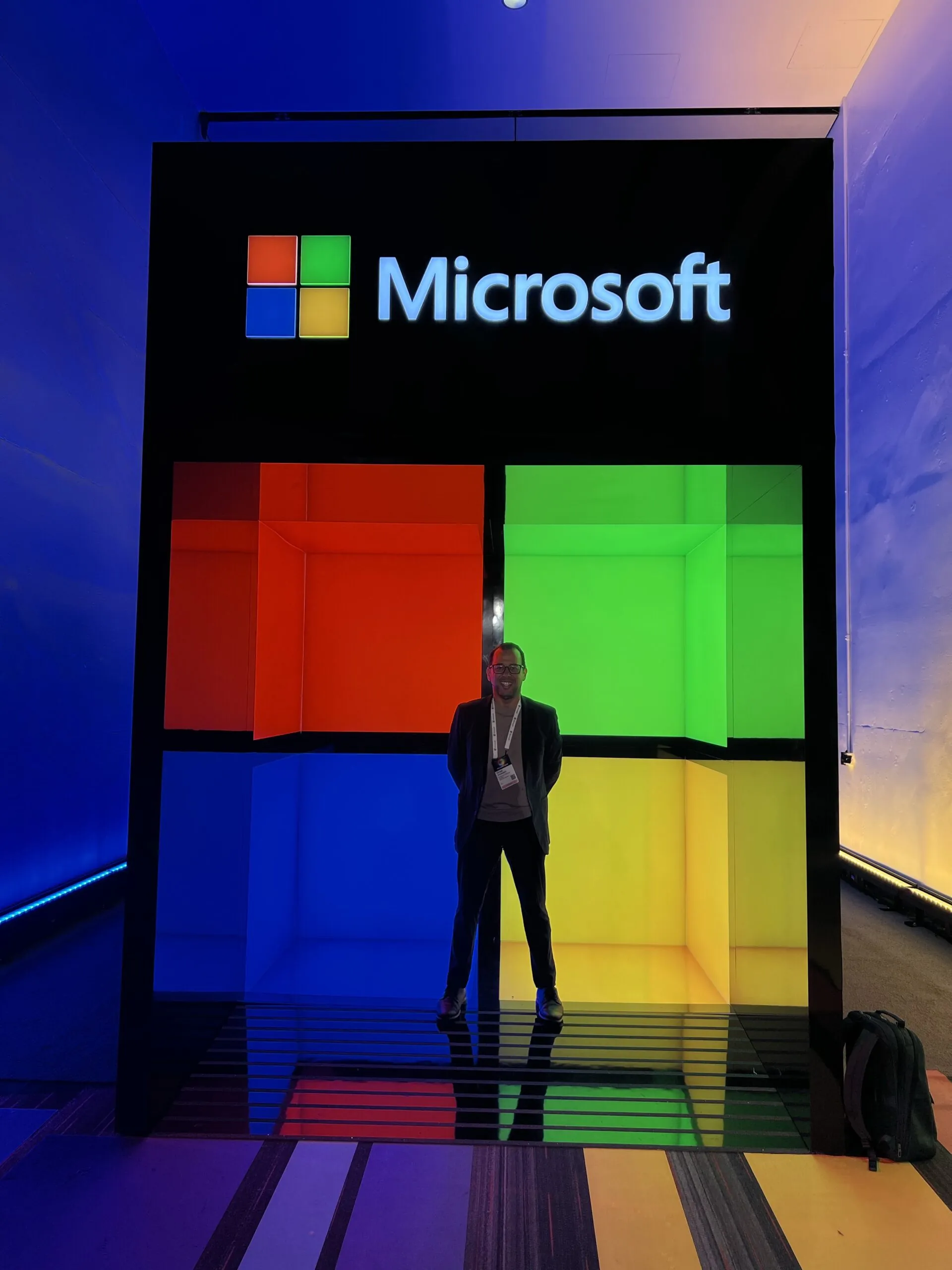
Our CEO, Prayaag Kasundra; Shravan Siramdas, Senior Vice President at Simform; and I attended together. I spend most of my time with enterprise leaders who are deciding where their next AI budgets go, so I listened for what would change those decisions.
1. Copilot is becoming the starting point for work, with agents working inside it
Microsoft’s message at Ignite was that Copilot is now “the new OS for work,” and I took it as a statement about delegation. The Copilot announcements give teams a graduated way to hand over work, and each level asks more of the business than the one before.
- Chat answers a quick question.
- Cowork takes on a whole workflow, and Microsoft says nearly 80% of Fortune 500 companies already use it.
- Autopilot, now rolling out to Frontier customers, runs recurring work such as a full supplier review.
How the buying conversation changes
As agents take on more of the work, the buying conversation changes with them. Until now, buying Copilot has largely meant deciding how many employees get a license.
The question now is which workflows to hand over and how far an agent can act before a person signs off. Only the team that runs a process can answer that, which is why the head of finance or operations increasingly shapes the deal alongside the CIO.
Companies already running on Microsoft can find those first workflows faster, because Copilot now works inside the business applications they use every day. Dynamics 365, for example, now brings more than 100 prebuilt skills for sales, service, and finance into Copilot.
Each workflow a business hands over also raises two practical questions.
- Accountability. Someone in the business has to answer for the agent.
- Cost. The budget has to cover both per-user subscriptions and usage-based pricing for heavier work.
Both questions assume the agent knows enough about the business to do the job well, and that is where the next announcement comes in
2. Agents are only as useful as the context behind them
An agent that drafts a forecast without the customer history behind it, or approves an expense without the policy that governs it, only creates work for someone else to fix.
That is why I see Microsoft IQ as the Ignite announcement with the longest reach. It gives agents a governed view of how the organization works, the state of the business, its policies, and timely information from the web.
Getting value from that view starts before any agent is built, because someone has to decide which sources count as the official version of the truth and who keeps them current.
Without that agreement, agents inherit the same inconsistencies people already deal with. If finance and sales define an active customer differently, two agents will give two different answers.
That is why we treat shared business definitions in Microsoft Fabric as the vocabulary agents work from, an approach we lay out in our guide to building agents on the Microsoft stack.
Context also shapes cost, because the information an agent draws on affects what it costs to run, which matters now that Copilot includes usage-based pricing. It all depends on the underlying data being in a state agents can use, and for many enterprises, it is not there yet.
3. The legacy estate now sets the pace for AI
For many enterprises, the data agents need still sits in systems built for monthly reporting, long before anyone planned for agents. Microsoft’s answer at Ignite was to put agents to work on the modernization itself.
Azure Catalyst, now generally available, brings Microsoft’s migration and modernization tools together in one agent-led experience. Microsoft pointed to Levi Strauss & Co., which has deployed more than 1,000 agents across its modernized enterprise systems.
With agents speeding up the migration work, the harder decision becomes what to modernize first. I would tie that order to the workflows a business has already chosen to hand to agents, so each system moves when an agent is ready to depend on it. That way, the modernization budget follows the same priorities as the agent roadmap.
When that first move is to Microsoft Fabric, our TrueMorph accelerator helps teams complete modernization work up to 60% faster, and we have shared lessons from real modernization programs that shaped it.
4. Every agent needs a business lead who answers for it
Once agents run real workflows on modernized systems, someone has to answer for what they do. Microsoft said at Ignite that “we need to be able to examine what AI sees and does, verify its actions independently,” and it shipped controls to match.
Agent governance announced at Ignite
- A sponsor for every agent. Automated lifecycle management for agent identities in Microsoft Entra is generally available, with policies that check whether each agent has a human sponsor, is still needed, and has been active recently.
- One standard across platforms. Microsoft is rolling out Entra Agent ID support for agents built on Salesforce Agentforce, Google Vertex AI, Databricks, Snowflake and Amazon AgentCore, with completion expected in December, so security teams can govern them alongside Microsoft agents.
- Scale that makes it urgent. More than 50 million agents already registered in Agent 365 since launch.
The role buyers should focus on is the sponsor, which Microsoft defines as a business representative accountable for the agent’s purpose and lifecycle, separate from the IT administrators who manage it technically. I would give that role to a business lead, the leader whose process the agent runs, such as a finance director whose team relies on an invoice agent.
Naming that person before deployment brings the right leader into the buying decision from the first conversation.
Naming a business lead works only when the decision rights around the agent are agreed before anything is built. Our ATOM framework (Agentic Target Operating Model) settles them for each workflow, from who approves what an agent produces to where a person must step in. Once agents are live, our ThoughtMesh accelerator applies those rules.
5. Production results will decide which agents get funded
Once every agent has a business lead, finance will ask that lead what the agent delivered, and Microsoft is making that question easier to answer. Agent 365 Business Analytics, now in Frontier preview, puts AI spend next to the work it produced, including assisted hours and success rates.
With cost and output side by side, an agent that visibly saves a team hours each week makes its own case for more funding. A pilot that cannot show results in daily work will find its budget much harder to defend.
What that evidence looks like in practice
The evidence that holds up in those reviews has three parts, and our work with a commercial HVAC services group shows each of them.
- The agent runs inside daily operations. The group’s technicians work at sites where connectivity is often weak, so we built an offline-first field operations platform where Microsoft Foundry agents turn on-site notes, photos, and receipts into structured reports and expense records.
- A person still approves what it produces. ThoughtMesh governs how those agents operate, and supervisors review and approve every record before it moves forward.
- The improvement shows up in numbers the business already tracks. Reporting effort is down by up to 80%, and manual expense logging is down by 60%.
That work made Simform a Global Finalist in the 2026 Microsoft Partner of the Year Awards, in the Innovate with Azure AI Apps and Agents category. We have shared the architecture behind it for teams planning similar work.
Results like these start with choosing the right first workflow, and that choice is easier when everyone involved works from the same plan
6. Customers, Microsoft, and partners need to see the same target state
Getting to one plan is harder than it sounds, because each takeaway so far touches a different part of the Microsoft stack. Microsoft describes the whole as a frontier ecosystem it is building with its customers and partners, and the risk for a buyer is meeting it one conversation at a time.
A Copilot discussion in one meeting, a data proposal in the next, and a security review after that can each carry a different picture of where the business is heading.
Microsoft’s partner keynote, led by Chief Partner Officer Nicole Dezen, addressed this from the partner side. It asked partners to start with Customer Zero, using AI in their own business first and documenting how they prepared their people, protected their data, and governed their agents.
Microsoft’s Ignite guidance for partners also asks them to bring each specific customer opportunity to Microsoft’s sellers with a shared plan for delivering value. For buyers, that guidance turns into two simple questions for any partner.
- Has it run agents in its own business, and can it show how it handled people, data, and governance?
- Is it working with your Microsoft account team on your opportunity, so you hear one plan from both?
FEED, our Frontier Enterprise Envisioning Demo, is how we build that shared plan with customers. It gives business and technology leaders a working view of how Microsoft’s data, AI, and Copilot capabilities would support their own scenarios, with security and governance built in.
The customer, Microsoft, and Simform can then agree on the first workflow before anyone funds it, and we have explained where FEED fits in our Microsoft delivery.
Plan your 2027 Agentic AI roadmap with Simform
Not everything announced at Ignite is ready to plan around yet. Several headline capabilities, including Autopilot and Agent 365 Business Analytics, are still in early access through Microsoft’s Frontier program. I would build 2027 plans around what is generally available today and treat those previews as a roadmap to prepare for.
Even with that focus, 2027 holds a full year of decisions, and they follow the order of this post.
- Which workflow goes first, and how much autonomy the agent running it should carry.
- What context and data the agent needs, and which systems to modernize first.
- Who leads the agent for the business, and where a person signs off.
- How its value will show up in the numbers finance reviews.
Simform supports enterprises through these decisions as a Microsoft Solutions Partner across Cloud & AI Platforms, Security, and AI Business Solutions, an Azure Expert MSP, and a Microsoft Fabric Featured Partner. If you are shaping your 2027 plans, a FEED session is a practical place to start because it gives your leadership team one view of the target state before the first workflow is funded.


