

 ChatGPT
 Perplexity
Modernizing legacy systems is the project every enterprise knows it needs, yet few feel confident funding. Multi-year timelines, uncertain ROI, and outage risk make it easy to defer to “next year.”
Technical debt makes the business case harder still: it accounts for roughly 40% of the technology estate (McKinsey), diverting 10–20% of technology budgets away from new products and capabilities.
But technical debt is a symptom. The deeper problem is coordination complexity: most enterprises run 200+ interconnected applications, and every change risks breaking something else.
What makes agentic AI different for legacy modernization?
Agentic AI differs from conventional modernization tooling in one fundamental way: agents don’t just analyze or recommend; they plan multi-step work, execute it, and adapt when systems behave unexpectedly, all within your security policies, compliance frameworks, and budget constraints.
| Conventional tools | Agentic AI | |
| Dependency analysis | Static scans; humans interpret results | Agents map the estate and sequence changes autonomously |
| Execution | Recommends; engineers implement | Executes coordinated changes across domains |
| Exceptions | Escalate every anomaly to humans | Adapts in real time; escalates only critical decisions |
| Coordination | Manual handoffs between app, data, and infra teams | Unified workstreams orchestrated by agents |
| Governance | Retrofitted after the fact | Guardrails embedded in agent workflows |
Gartner predicted that 40% of enterprise applications would integrate task-specific AI agents by the end of 2026, up from less than 5% in 2025 – an eightfold jump in a single year. For modernization, this means the tools enterprises use to manage transformation are becoming agent-native, not just agent-compatible.
Four agentic AI capabilities that make modernization predictable
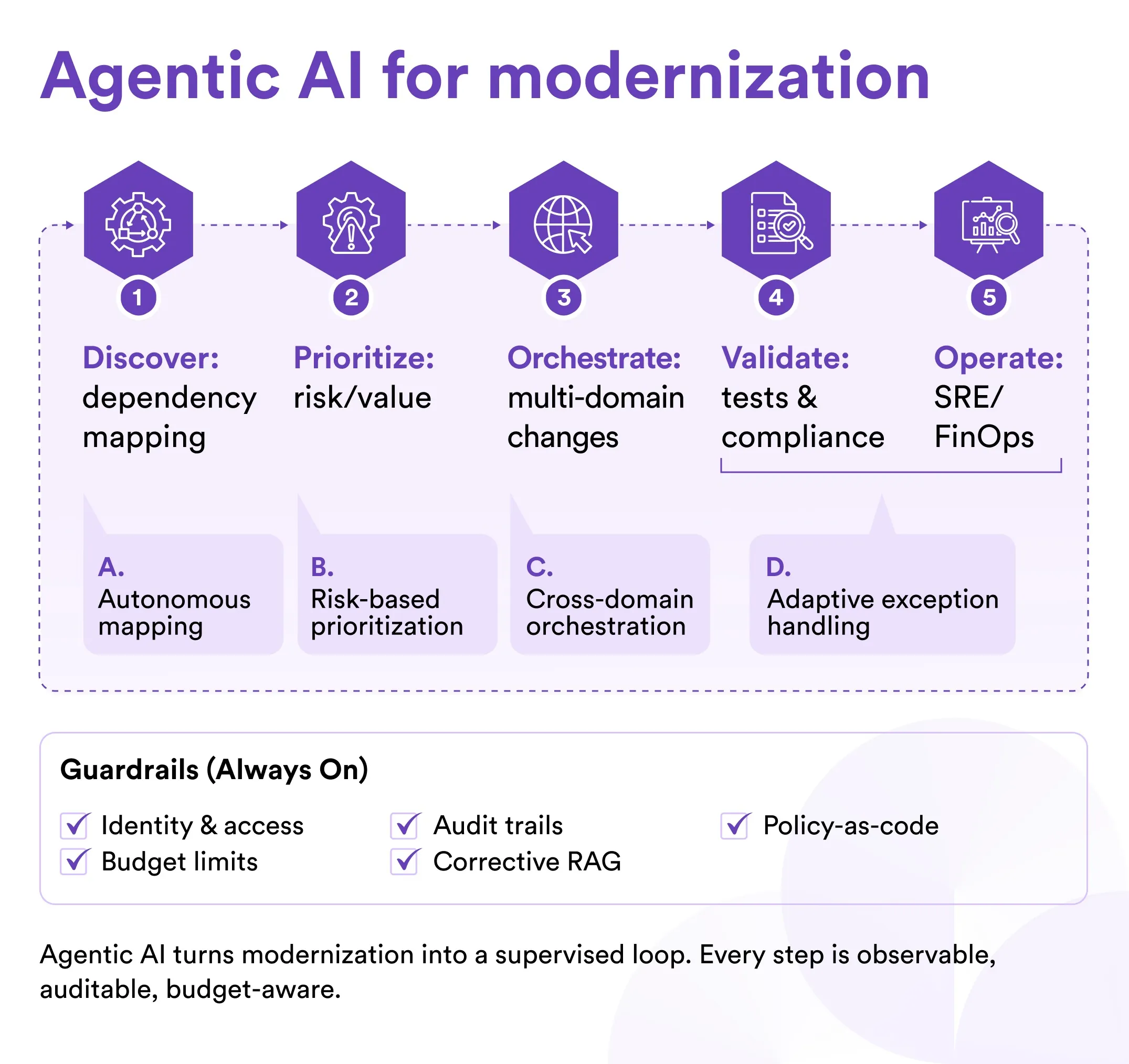
Autonomous dependency mapping and sequencing. AI agents scan the entire application and data estate to understand how changes to core systems cascade through customer portals, analytics dashboards, and partner integrations. The agents then sequence updates to prevent downstream failures while optimizing for business continuity.
Cross-domain orchestration. AI agents coordinate application updates, infrastructure provisioning, and data pipeline migrations as unified workstreams. This eliminates the handoff delays that typically extend enterprise projects by months and keeps data flows reliable throughout modernization.
Risk-based prioritization with data governance built in. Rather than following arbitrary phases, AI agents analyze which systems pose the highest operational risk or deliver the greatest business value when updated. The same agents update data validation rules, schema changes, and analytics feeds so business intelligence doesn’t break downstream.
Adaptive exception handling. When legacy systems respond differently than expected, AI agents adjust the approach in real time. They resolve routine issues autonomously and maintain context about business requirements to choose alternative pathways, escalating only decisions that genuinely need human judgment.
Microsoft’s multi-agent architecture shows agents coordinating in production
Microsoft’s Azure architecture for loan processing demonstrates these capabilities working together. Triage agents break complex requests into coordinated tasks, coordinator agents sequence interdependent workflows, and specialized agents handle document verification and compliance validation. In that loan-processing scenario, the multi-agent architecture coordinates work that previously required 30–60 days of manual handoffs between underwriters, compliance teams, and processors.
Microsoft has been shipping production capabilities to support this pattern. In December 2025 and January 2026, Microsoft Foundry (formerly Azure AI Foundry) added managed long-term memory for agents, an Agent-to-Agent (A2A) tool for calling external A2A-protocol endpoints with structured authentication, and a cloud-hosted MCP server for secure, zero-setup agent connectivity.
For legacy code specifically, GPT-5.1 Codex Max became generally available in Foundry with a 400K-token context window and support for multi-agent coding pipelines, including refactoring .NET and Java applications.
How to modernize legacy systems with agentic AI?
Agentic AI modernization works domain by domain — in a phased and controlled sequence. The sequence that works in practice:
- Assess the estate – agents inventory applications, data, and infrastructure and map dependencies.
- Prioritize by risk and value – modernize the systems that pose the highest operational risk or unlock the most business value first.
- Deploy purpose-built agents per domain – applications, data platform, infrastructure, operations.
- Embed governance in the workflow – access controls, audit trails, and validation gates inside agent pipelines, not bolted on after.
- Move to continuous optimization – SRE, FinOps, and data reliability agents keep modernized systems healthy.
The four domains below show what each stage looks like in production.
Legacy application modernization: agents that rewrite code to your standards
Applications built on outdated frameworks are expensive to maintain and impossible to extend. Manual modernization takes months per application and risks breaking business-critical functionality.
The agentic approach starts with configuration, not code. Teams encode their expertise into agents through structured prompts, business context, coding-style fine-tuning, and validation criteria. The agents then execute. One focuses on code analysis and rewriting against your development standards, another applies quality validation rules from your QA processes, and a third handles build and runtime testing based on your DevOps practices.
Visma: 40% less human effort on a 3-million-line .NET application
Visma, a €2 billion fintech company with 400+ SaaS products, used specialized agents – combined with Microsoft’s .NET Upgrade Assistant and GitHub Copilot – to modernize Flex HRM, a 3-million-line .NET application maintained by 30 developers. The result: a 40% reduction in human effort and €600,000 in annual cost savings. Visma’s team went from 0% to 100% AI adoption almost overnight because developers could see exactly what each agent was doing and retain control of the process.
“From legacy to cloud native: Accelerating Modernization at scale and AI | BRK199” – Microsoft Developer channel
How NeuVantage and CodeTools accelerate application modernization
NeuVantage uses AI to analyze technology portfolios and map modernization pathways based on the 5R strategy. It automates application inventory creation, segments complex codebases for deeper analysis, and produces cloud-ready modernization blueprints that have accelerated application modernization by up to 40% in Simform engagements.
CodeTools provides structured AI automation across the development lifecycle: a curated prompt library that standardizes tasks like test-case and documentation generation, plus GitHub Copilot extensions for consistent pull-request reviews, automated quality checks, and Infrastructure-as-Code workflows. Instead of developers learning AI tools in isolation, CodeTools creates an integrated automation foundation that enforces quality standards while cutting delivery costs.
Data platform modernization: agents that govern while they migrate
Data scattered across disconnected systems produce static dashboards that can’t deliver insights fast enough, and traditional platforms need months of engineering just to integrate a new CRM or data stream. In Anthropic’s survey of more than 500 technical leaders, 46% identified integration with existing systems as a major barrier to scaling AI agents, while 42% cited challenges related to data access and quality.
The agentic solution is a hybrid model. Agents assist with data discovery and relationship mapping using pre-configured governance rules, automate routine validation checks against established compliance processes, and optimize pipeline monitoring. Humans validate critical decisions, reducing manual effort on routine work, while preserving enterprise governance controls.
NTT DATA: 50% faster time-to-market with Fabric data agents
NTT DATA, a $30 billion global technology services provider, used Microsoft Fabric data agents and Azure AI Agent Service to replace static dashboards with conversational agents that deliver role-specific insights in natural language. Their HR operations agents analyzed workforce data in real time, surfacing staffing and productivity patterns that manual reporting missed. NTT DATA achieved 50% faster time-to-market for data solutions, enabling teams to ask questions and get actionable answers instead of waiting months for a dashboard change.
How TrueMorph, Data360, and ThoughtMesh modernize enterprise data
TrueMorph, Simform’s AI-powered data platform modernization accelerator, automates the move from legacy systems to AI-ready data ecosystems. It- speeds up discovery, dependency mapping, conversion, coexistence planning, and cutover so transitions stay predictable without downstream rework. Governance is embedded from day one. The platform automatically identifies and masks sensitive data, applies quality checks, maintains a verifiable audit trail across environments, and structures modernization on the Bronze–Silver–Gold framework with self-healing validation, anomaly detection, PHI/PII masking, and human-in-the-loop review for business logic.
Data360 provides composable customer data infrastructure: modular components customizable independently without disrupting the stack, built-in data governance layers, flexible customer profiling, and AI-powered conversational interfaces for natural-language data access.
ThoughtMesh lets agents operate on trusted enterprise knowledge through an agent management and orchestration framework with no-code workflow builders, namespace-driven security controls, and corrective RAG that minimizes hallucinations. It transforms enterprise data into AI-ready formats through vectorization pipelines, so agents access the right information with proper security controls.
Infrastructure and security modernization: agents that enforce well-architected patterns
Modernized applications on a weak infrastructure foundation inherit the same fragility at higher cost. Infrastructure AI agents generate Infrastructure-as-Code templates (with expert validation for complex environments). Security architecture agents model resiliency patterns, flag anti-patterns like single points of failure, and suggest zero-trust configurations with specialist oversight and staged rollouts for enterprise compliance.
Cognition: 50% lower project costs scaling Devin on Azure
Cognition needed an enterprise-grade infrastructure to scale its Devin AI agent across large organizations. Working with Microsoft Azure, Cognition used infrastructure agents to assist environment provisioning and security architecture agents to support enterprise compliance. This cut project costs by 50% and enabled confident scaling to enterprise customers, including Visma.
How Simform’s AI-WAFR Bot automates architecture reviews
Simform’s AI-WAFR Bot automates well-architected framework reviews by analyzing Terraform configurations against Azure’s WAF best practices in minutes rather than days. Powered by Azure OpenAI, it detects misconfigurations, security gaps, and performance inefficiencies. The agent then generates context-aware fixes, produces JSON reports with risk levels and remediation suggestions, and integrates into CI/CD pipelines for continuous compliance checking. An integrated Terraform Assistant offers real-time conversational support for code improvements.
Operations: SRE, FinOps, and data reliability agents keep modernized systems healthy
Once applications and data are modernized, they need to run reliably with fast recovery. Specialized autonomous agents embed in platforms like Azure Monitor, Google FinOps Hub, Databricks, and Acceldata:
- SRE agents (Azure) automate incident detection and resolution, enabling real-time remediation with less manual intervention.
- FinOps agents continually analyze cloud unit economics and trigger actions that align budgets and scheduling with actual usage.
- Data reliability agents autonomously maintain pipeline health, validate schemas, and detect data drift across Azure and hybrid architectures.
The results are already measurable at scale. Running SRE Agent internally as “Customer Zero,” Microsoft has handled 35,000+ incidents autonomously and cut Azure App Service time-to-mitigation from a 40.5-hour human-only average to 3 minutes. Early enterprise adopters reported the same pattern: banking-software provider Zafin took incident triage from hours down to minutes after shifting to agent-driven response.
How Simform governs agentic modernization at enterprise scale?
Deploying AI agents at enterprise scale raises three governance challenges: security teams need granular access controls that stop agents overstepping system boundaries, compliance officers need audit trails proving AI decisions meet regulatory standards, and engineering leaders must eliminate hallucination risks that could corrupt production business logic.
Simform’s accelerators embed those controls directly into agent workflows rather than retrofitting oversight after deployment:
- NeuVantage gives agents verified architectural intelligence with accurate codebase mapping and dependency analysis that prevent hallucination-driven errors in critical business functions.
- CodeTools embeds development expertise into structured agent workflows, with automated quality reviews and compliance validation inside the development process.
- Data360 delivers composable data governance that scales with agent operations, including built-in compliance layers and modular access controls that keep agents within authorized data boundaries.
- ThoughtMesh secures enterprise knowledge through namespace-driven access controls, with corrective RAG validation against trusted sources.
- AI-WAFR Bot validates infrastructure changes against governance requirements before deployment and generates the audit documentation regulators require.
- TrueMorph embeds trust into data modernization with automatic sensitive-data masking, quality checks, and verifiable audit trails across every environment.”
This approach gives CIOs a clearer path to modernization, with measurable outcomes, managed risk, and delivery expertise that can scale across the application portfolio.
Frequently asked questions on agentic AI modernization
How is agentic AI different from using GitHub Copilot for modernization?
Copilot assists an individual developer inside the editor; agentic AI coordinates the whole program. Autonomous agents map dependencies across the estate, sequence changes to avoid downstream failures, execute coordinated updates across applications, data, and infrastructure, and adapt when systems respond unexpectedly. Copilot is often one tool inside an agentic pipeline – Visma combined it with specialized agents and Microsoft’s .NET Upgrade Assistant.
How long does agentic AI modernization take compared to manual approaches?
Manual modernization typically takes months per application because of handoffs between application, data, and infrastructure teams. Agentic approaches compress this by running those workstreams as coordinated, agent-executed pipelines: Visma cut human effort 40% on a 3-million-line application, and NTT DATA cut time-to-market for data solutions by 50%. Exact timelines depend on estate size, dependency complexity, and governance requirements – which an assessment maps first.
Is it safe to let AI agents modify legacy production code?
Yes – when governance is embedded in the workflow rather than bolted on. Production-grade agentic pipelines encode your coding standards, QA validation rules, and deployment gates into the agents themselves, keep humans approving critical decisions, and maintain full audit trails. The same principle applies on the data side: Simform’s TrueMorph accelerator pairs self-healing validation and automatic sensitive-data masking with human-in-the-loop review for business logic. Visma’s team adopted agents rapidly precisely because developers could see exactly what each agent was doing and retain control.
Which systems should an enterprise modernize first with agentic AI?
Start where operational risk or business value is highest – not with an arbitrary phase plan. Agents assess the estate, map dependencies, and rank systems by risk and value; the 5R strategy (rehost, refactor, rearchitect, rebuild, replace) then maps each application to the right transformation path. A portfolio analysis, like the one NeuVantage automates, typically precedes any code change.
What does agentic AI modernization cost, and how is it funded?
Costs depend on estate size and the transformation path per application, but the funding logic changes: agentic modernization converts an unpredictable multi-year program into a domain-by-domain sequence with measurable checkpoints. Production results – €600,000 annual savings at Visma, 50% lower project costs at Cognition – give CIOs the predictability that makes the business case fundable. A scoped assessment is the usual first investment.


