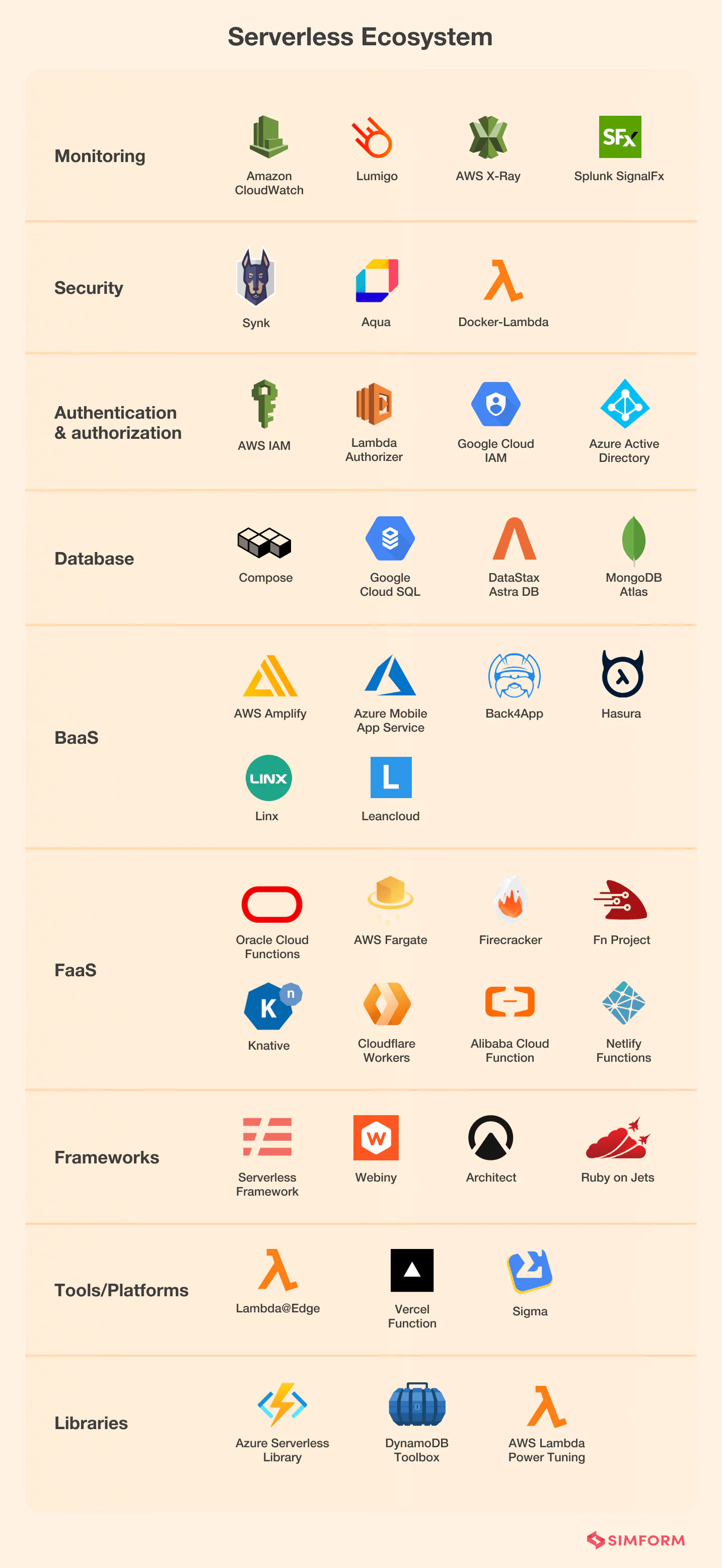
In July 2017, Gartner released its Hype Cycle for Emerging Technologies report, which highlighted the growing interest in serverless technologies. At the time, serverless computing was positioned in the “Innovation Trigger” phase, signaling the early stages of experimentation and adoption.
Since then, serverless technologies have significantly evolved and transformed the way modern applications are built and deployed. Serverless computing enables developers to focus on writing application logic without managing the underlying infrastructure. Cloud platforms such as Microsoft Azure now provide fully managed serverless platforms like Azure Functions, allowing teams to build scalable and event-driven applications while automatically handling provisioning, scaling, and infrastructure management.
In this guide, we’ll explore the serverless ecosystem in detail. While many innovations in this space are driven by open-source frameworks and community projects, cloud providers continue to expand their managed serverless offerings to simplify development and operations.
As organizations increasingly adopt microservices, event-driven architectures, and cloud-native development practices, serverless technologies are becoming an important part of modern application architectures.
As serverless adoption continues to evolve, having the right engineering approach becomes critical. At Simform, we work with enterprises to design and build cloud native solutions aligned with their application and business requirements
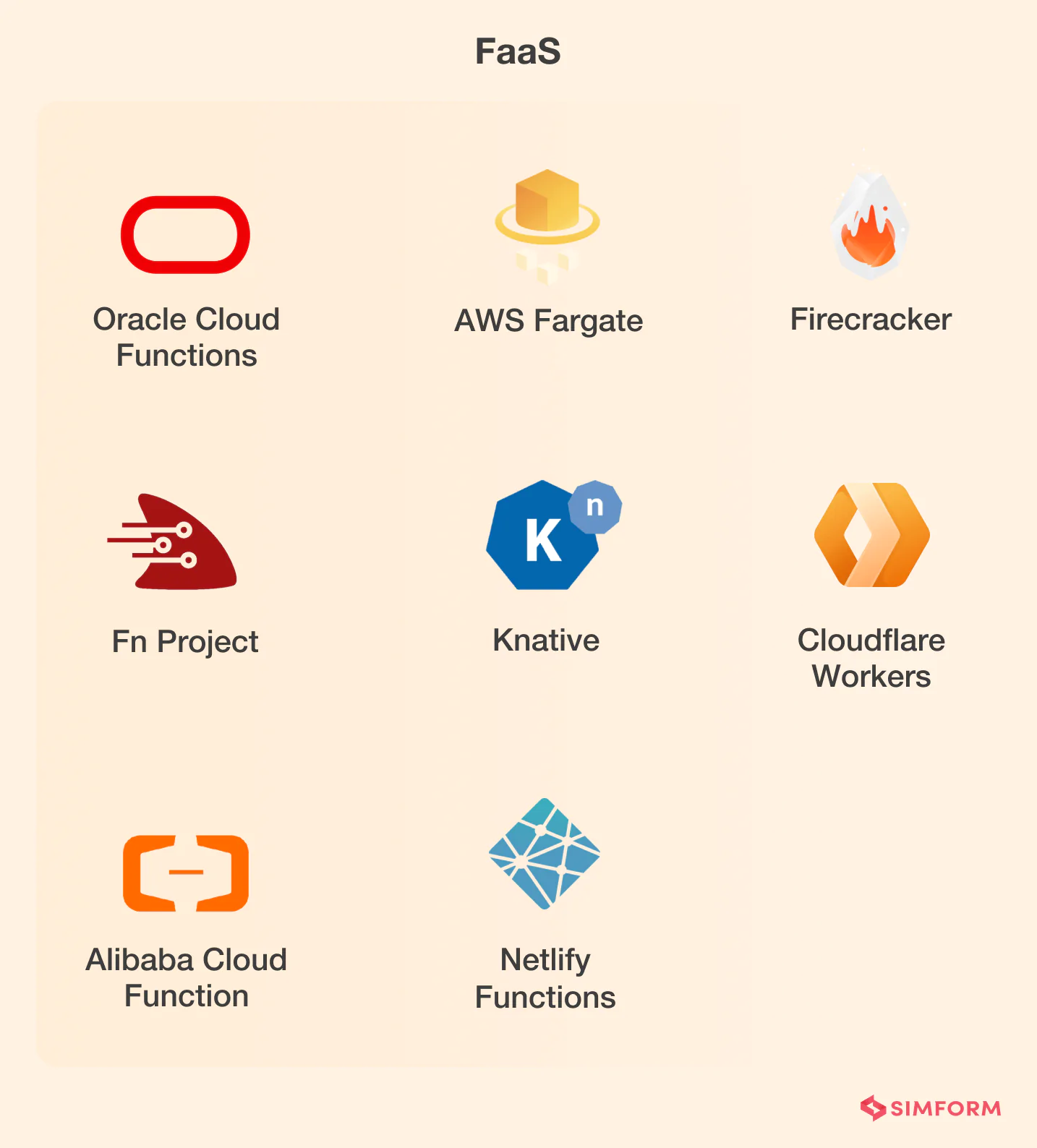
A serverless platform that focuses on the creation of cloud-ready applications that can be easily ported to on-premise environments or any given cloud platform. It provides the ability to scale and manage applications without managing infrastructure. Moreover, it also supports various programming languages such as Go, Java, Python, Node, etc.
A serverless computing engine compatible with Amazon Elastic Container Service (ECS) and Amazon Elastic Kubernetes Service (EKS). It helps manage apps without focusing on the infrastructure and removes overhead costs in operations such as securing, patching, etc. Also, it offers a pay-as-you-go subscription.
An open-source, serverless, and lightweight Virtual Machine (VM) known as microVM helps leverage containers’ full resource potential. Built by AWS, it helps improve the serverless customer experience provided for services such as AWS Lambda and AWS Fargate. Firecracker is also considered a VM Monitor (VMM).
A serverless platform that is container-native and can run on any cloud and on-premise system. Unlike other FaaS, Fn Project is not complicated to use despite its container-centric services. It is highly performant and scalable. However, its compatibility with all programming languages is still in the pipeline.
A platform that helps manage serverless workloads in terms of build and deployment powered by Kubernetes. Created by Google, it can autoscale and support third-party data center requirements. It is compatible with any development language framework and is highly flexible for all necessities that may arise in CI/CD processes.
A widely developer-supported platform that helps deploy serverless code at scale without affecting the application performance. It focuses on avoiding cold-starts and supports 0ms performance on a global scale. Accessibility to readily available templates and tutorials are a few major benefits for creating serverless functions.
It is an event-driven, fully-managed serverless computing platform that focuses on improving service elasticity for executing automated serverless functions seamlessly during peak traffic hours. It does not charge any fee for 400,000 CU-second computations resourced per month and 1,000,000 invocations.
A workflow-centric FaaS platform that focuses on neatly deploying globally static assets on serverless-based functions with real-time computation. It can run on AWS Lambda and supports JavaScript (JS), TypeScript (TS), Go, etc. Pricing of Netlify ranges from free with limitations to premium with unlimited run time per month with support for customized deployments to AWS.
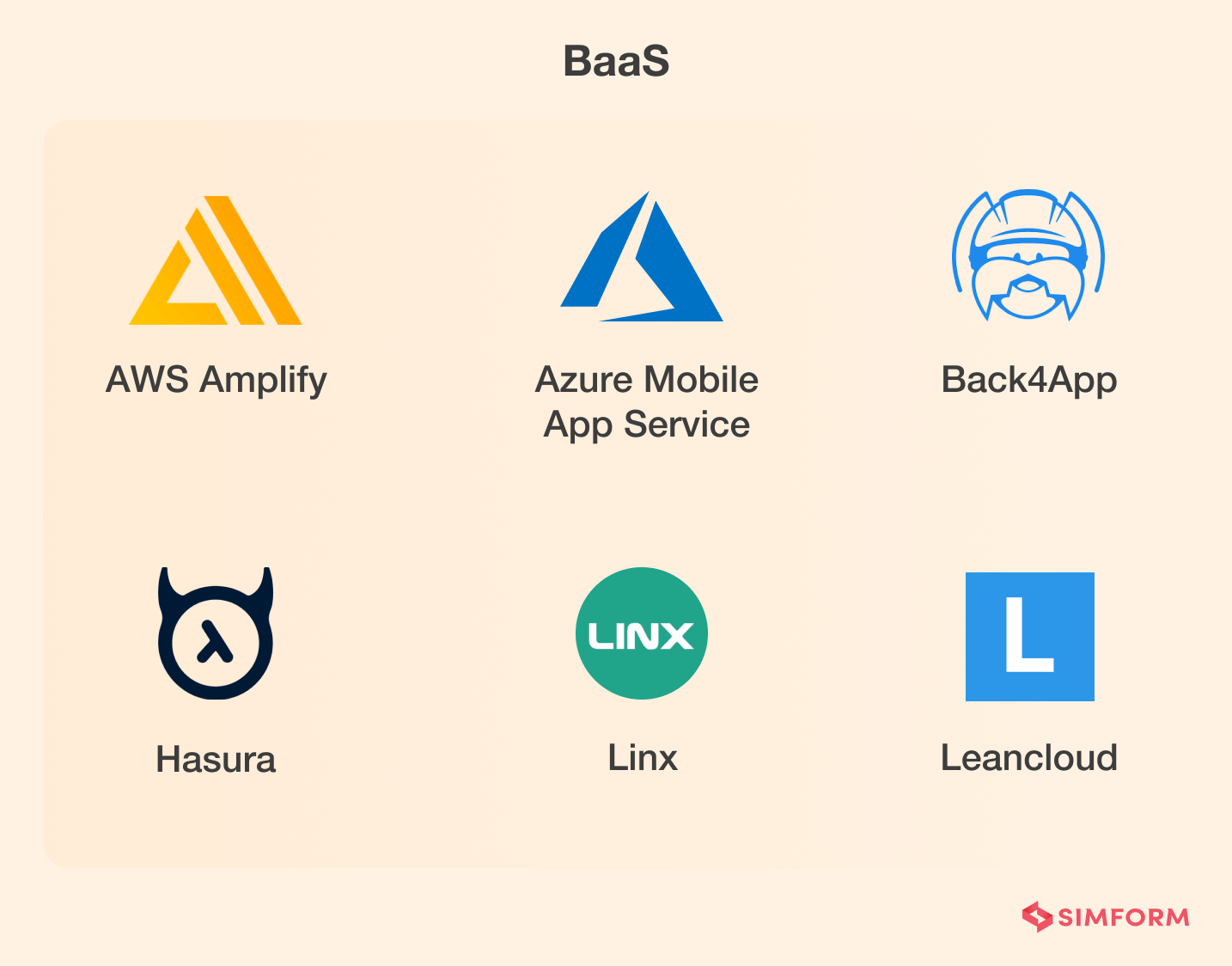
Be it a static website or Single Page Application (SPA), AWS Amplify is a fully-stacked platform that emphasizes the visual development of the backend. It eases the building, deploying, and hosting services for authentication, data, storage, and more. Creating mobile or web apps with guided workflow and real-time functionalities takes only minimal time under a few clicks.
A backend service-centric platform that supports the creation of apps that can work offline and sync with social media features. It can autoscale to millions of devices across multiple platforms and easily add backend logic using NodeJS or C#. Microsoft also spends more than USD 1 billion to secure this platform and ensure its privacy.
A serverless platform that focuses on building backend relational data models with complex queries in a few minutes. It focuses on less coding to build modernized apps with accessibility to GraphQL and REST at scale. Easily add business logic to a given app using cloud functions for cross-platforms. It also supports various iOS, Android, Flutter, and .NET SDKs.
It is a platform that allows development teams to run serverless backend services such as API performance improvement, authorization, caching, etc., locally or on the cloud instantly. Hasura is open-sourced and supports various databases such as Google Big Query, Amazon Aurora, SQL Server, etc. It also provides the freedom to achieve linear scalability.
A low-code platform for developers that allows them to build and host APIs, automation, and integrations. It eliminates the need for code, frameworks, or infrastructure, integrates with microservices architecture, and is compatible with any tech stack. Linx also offers built-in management, monitoring, and metrics for hosting solutions on-premise or in the cloud.
A serverless backend platform for storing data, building server-side logic, leveraging instant messaging, and providing real-time P2P backend connection between users. The SDK of LeanCloud functions natively and supports all major programming languages such JS, Python, PHP, .NET, Swift, etc. The serverless backend of this platform focuses on the gaming industry.
Compose is an enterprise-level cloud-based database platform created by IBM. It offers data isolation and segregates data layers according to the app requirement which allows developers to focus on building serverless apps and not manage databases. The platform supports various databases like MongoDB, Redis, MySQL, Elastisearch, ScyllaDB, etc.
It’s a fully-managed SQL-centric database service backed by Google Cloud and focuses on running database-related operations on SQL, PostgreSQL, and MySQL with rich extensions and configurations. It is a self-managed database ecosystem on the cloud and is highly reliable and supported by a 24/7 Site Reliability Engineer (SRE) team.
A multi-cloud stack database for data-centric modern apps. DataStax ensures serverless apps are Apache Cassandra-ready through simple API integrations. It is compatible with Kubernetes and offers to scale NoSQL databases. The creation of Streaming-as-a-Service is its Unique Selling Proposition (USP).
It is a MongoDB-based database service hosted on the cloud and runs on AWS, Azure, and the Google Cloud. Built with powerful features, this platform provides the necessary tools to build a mission-critical and production-ready database for cloud-ready apps. It avoids single-point failures, supports multi-region fault tolerance, and enables point-in-time data recovery.
For a deeper understanding of serverless databases in event-driven architectures, explore our detailed blog.
It is a customized library that allows authentication-related operations to run on AWS Lambda, which serves to be useful for apps that follow the Microservices Architecture. The main focus of the Custom API Authorizer is to authorize necessary functions or APIs before the business logic is allowed to run. The use case of this library is to protect API routes for authorized users.
It offers granule access over who can access what resources under which conditions. It is a privileged permission-based workforce system for cloud-ready apps and serverless operations. Singe Sing-on (SSO) is one of its features that leverages AWS SSO to grant workforce users streamlined permission to set conditions, verify authentication and refine app control.
It is an API-centric authorizer created by AWS for Lambda to have controlled access over any APIs. This is a useful authorizer when implementing a customized authorization scheme in a serverless app to determine user identity. It also uses IAM, OAuth tokens, and JSON Web Tokens (JWT) to create an immutable API Gateway.
Similar to other IAM platforms, this is a cloud-resource access and control platform created by Google for the Google Cloud. It offers an enterprise-grade administration system with built-in auditing features to ease the process of compliance policies set for a given serverless app. The platform is simple, clean coded, and provides a universally understandable interface.
It is an enterprise identity service with a multi-factor authentication system. It guarantees to protect the serverless operations against 99.9% of the cybersecurity attacks. Also, it provides the ability to synchronize all on-premise directories to establish central control at all times. Be it on-site or remote, it offers opportunities to automate workflows seamlessly.
It is a monitoring suite with rich metrics to monitor AWS Lambda and more. It enables you to receive instant results on tracking functions like errors, invocations, cold starts, API Gateway failures, etc. This monitoring tool can create metrics automatically based on the app’s configuration. It tracks data such as API requests, queues, and more and also, offers a visual dashboard.
An observability service created by AWS for AWS resources and apps that run on it. It is best suited for DevOps engineers and SREs looking for actionable decisions based on insights received from monitoring an app. CloudWatch supports a wide range of AWS services and triggers serverless workflows with AWS Lambda, SNS, and more.
A one-click platform that allows developers to debug and monitor serverless-based cloud apps conveniently. Since it also supports microservices environments, the scope of monitoring with Lumigo is considered helpful in scaling systems. This platform also provides visualization of the entire environment that needs monitoring, including all API calls and AWS services.
A leading debugging tool that caters to the AWS infrastructure. It is compatible with managing the monitoring processes of all serverless apps, especially those with Microservices under production. X-Ray is AWS Lambda-ready and provides robust features to determine app behavior, discover app issues by understanding its performance pattern, and more.
Acquired by Splunk, SignalFx is a real-time observability platform for cloud-native apps and technologies used for building serverless functions, Microservices, and more. It can also monitor container-related operations undertaken by Docker and Kubernetes. Be it data silos, data centers, or cloud storage, this platform is a one-stop solution for all.
What Tools are Available for Monitoring Serverless Applications?
It is a feature of Amazon CloudFront that allows developers to run codes without latency at the users’ end. By simply uploading the necessary code to AWS Lambda, Lambda@Edge helps scale and run codes with high performance and zero server administration. In the process, it also helps to establish a highly responsive Content Delivery Network (CDN) on the cloud.
A platform that allows deployment of any serverless function without changing or adding new configuration to the existing application. This is possible as it runs codes through MiddleWare, bridging the users’ and serverless ends. It offers guaranteed 100x faster startup of functions on containers or VMs.
It’s an IDE built for making serverless development seamless and easy. It is based on the drag-n-drop concept to reduce the burden of configuration and integration on the cloud. Monaco Editor powers it, and as a result, the IDE provides auto-completion even while writing codes. Sigma is context-aware and intelligent, which helps to reduce coding mistakes.
It is a community-based library created for Microsoft Azure and comprises more than 164 libraries that help with various services, including serverless DB handling, storage queuing, functional templates, and more. Whether it’s on-demand cost calculation or data cleaning, there is a library for everyone.
A simple library that comprises tools to enhance the functionalities of Amazon DynamoDB and its relation with serverless services. The infrastructure of this library follows the concept of Single Tables to ensure it can easily generally any API parameter. Nevertheless, it can work well with multiple tables as well.
An open-source tool library that helps to visualize the configuration of functions associated with AWS Lambda. Fine-tuning the memory and power required for Lambda functions to run is also possible. This library focuses on optimizing the speed and cost of development. It helps create CPU-intensive serverless Functions at a cheaper price for faster power.
Easily integrate and protect the serverless app with Synk’s tight AWS Lambda and Heroku integration. Monitor deployed codes, identify vulnerable dependencies, establish API Keys, and specific or set triggers for functions that require continuous monitoring. In addition to that, communication between the API and any given platform can be secured.
Ensure security compliance for Serverless apps with Aqua. Its services include deployment control, runtime protection, reduction of the attack surface, and optimization of performance controls. Like web app security, gain insights into vulnerabilities and establish a risk-free serverless with OWASP top 10 protection.
It’s a library that serves as a staging environment for AWS Lambda via Docker images. With the help of a sandboxed local environment, create an identical environment of a serverless app and establish specific permissions or control over file structure, environment variables, etc. It also allows the compilation of native dependencies to test the replicated Lambda environment.
Integrate IoT services to build a modern serverless architecture compatible with AWS Lambda, Google CloudFuntions, Azure Functions, etc. This framework allows operating efficiently with less management and more room for coding and scaling at a reduced running cost. Use-cases are limitless!
A serverless framework that allows developers to deploy to AWS with a single command. It is highly scalable and available to create GraphQL APIs, serverless full-stack apps, and websites. It allows customization of business logic to handle the complexities automatically. The creation of multi-tenant Microservices architecture is also possible.
It is a simple framework tool used to build powerful APIs and web apps that run on cloud functions, which is Serverless in this case. Installation, creation of new projects, and deployment are easy and undertaken via NodeJS. Hosting and starting a local serverless via code and shipping codes to a built-in production environment are some of its benefits.
Backed by the framework Ruby, Jets is a standalone framework that eases the development and deployment of serverless services on AWS with Ruby. It is also compatible with DynamoDB, RDS, CloudWatch, Ret APIs, S3, and more, and provides the best possible approach for creating powerful serverless web and mobile apps.
Looking to move to the cloud?
Let our extended team be part of your journey and help you step into the cloud.
Conclusion
The serverless ecosystem continues to evolve, with a growing range of tools and platforms shaping how modern applications are built and deployed. However, the focus should remain on selecting the right architecture based on application needs, scalability requirements, and operational goals.
A well-defined serverless approach can help organizations simplify infrastructure management while improving agility and cost efficiency over time.
Hiren is CTO at Simform with an extensive experience in helping enterprises and startups streamline their business performance through data-driven innovation.
We use cookies to enhance your browsing experience, serve personalised ads or content, and analyse our traffic. By clicking "Accept All", you consent to our use of cookies.
How we use your personal information
We do not collect any information about users, except for the information contained in cookies. We store cookies on your device, including mobile device, as per your preferences set on our cookie consent manager. Cookies are used to make the website work as intended and to provide a more personalized web experience. By selecting ‘Required cookies only’, you are requesting Simform not to sell or share your personal information. However, you can choose to reject certain types of cookies, which may impact your experience of the website and the personalized experience we are able to offer.
We use cookies to analyze the website traffic and differentiate between bots and real humans. We also disclose information about your use of our site with our social media, advertising and analytics partners. Additional details are available in our Privacy Policy.
Required cookiesAlways Active
These cookies are necessary for the website to function and cannot be turned off.
Optional cookies
Under the California Consumer Privacy Act, you may choose to opt-out of the optional cookies. These optional cookies include analytics cookies, performance and functionality cookies, and targeting cookies.
Analytics cookies
Analytics cookies help us understand the traffic source and user behavior, for example the pages they visit, how long they stay on a specific page, etc.
Performance cookies
Performance cookies collect information about how our website performs, for example,page responsiveness, loading times, and any technical issues encountered so that we can optimize the speed and performance of our website.
Targeting cookies
Targeting cookies enable us to build a profile of your interests and show you personalized ads. If you opt out, we will share your personal information to any third parties.