CarSaver: A complete one-stop solution for all your car buying requirements

Category: Automobile/SaaS

Services: Managed Engineering Teams, Resilience, Data Recovery Planning and Implementation, Fault Tolerance, DevOps, Cloud Architecture Design, and review.

Carsaver
  • Reduced the recovery time objective (RTO) to under 1 hour
  • Increased tenant onboarding efficiency by 40%
  • Reduced configuration errors by 75%.
  • Achieved  99.99% availability for the platform

About CarSaver

CarSaver provides an advanced solution for purchasing, renting, leasing, insuring, and upgrading cars. It lets users choose cars from over 30 automobile brands, such as Hyundai, Mercedes-Benz, Mazda, Volvo, and Porsche.

Challenges

  • Ensure resilience while users browse through products from more than 30 brands and ensure secure transactions.
  • Design the architecture for workload deployment for high availability when more users interact with the platform.
  • Develop a secure and efficient multi-tenant solution for data separation and access control.
  • Establish an efficient system to identify eligible customers, generate personalized upgrade offers, and manage the process.
  • Develop and implement a recurring marketing and lead nurturing process. 
  • Utilize a database to track lead data and marketing activities.
  • Develop a service that provides trade recommendations for pre-owned cars while keeping track of customer preferences and transaction history.
  • Ensure compliance with data protection regulations by securely storing customer data within the organization.
  • Ensure AWS resource configuration compliance with automated security alerts.
  • Use a dependable data store for storing configuration settings to simplify infrastructure management. 
  • Connect the current Single Sign-On (SSO) system with AWS resources in a secure manner, enabling remote access.

Proposed Solution & Architecture

  • Designed a scalable and resilient architecture design for the platform to ensure high availability during peak hours.
  • Integrated current SSO systems with AWS infrastructure to ensure secure remote access
  • Our team used AWS ECS for container orchestration to check eligible customers and generate deals. 
  • We leveraged AWS Lambda to perform calculations and DynamoDB to store customer data.
  • We leveraged Amazon RDS as the data storage service for storing trade-related data.
  • Implemented multi-tenant solution using DynamoDB for data separation and secure access control.
  • Our team used AWS Lambda functions for finance amount calculations and result delivery to users.
  • We leveraged AWS ECS to deploy workloads across multiple availability zones, improving the resilience and minimizing the impact of outages in single-zone
  • Our experts used ELB for load balancing and ensuring that the traffic is routed to healthy instances, maintaining higher resilience and system stability.
  • We implemented AWS auto-scaling to ensure higher load-handling capabilities, allowing the system to scale up or down based on increased load requirements.

Metrics for Success

  • Achieved an RTO to less than 1 hour  for rapid data recovery in the event of a disruption
  • Increased tenant onboarding efficiency by 40%, ensuring the application was resilient and scalable based on changes in demand.
  • Remediated 90% of resource configuration violations within minutes, improving operational stability and system resilience.
  • Improved application resilience with DynamoDB, reducing configuration errors by 75%.
  • Achieved the system availability of 99.99% to provide a reliable and uninterrupted service leveraging AWS ECS.

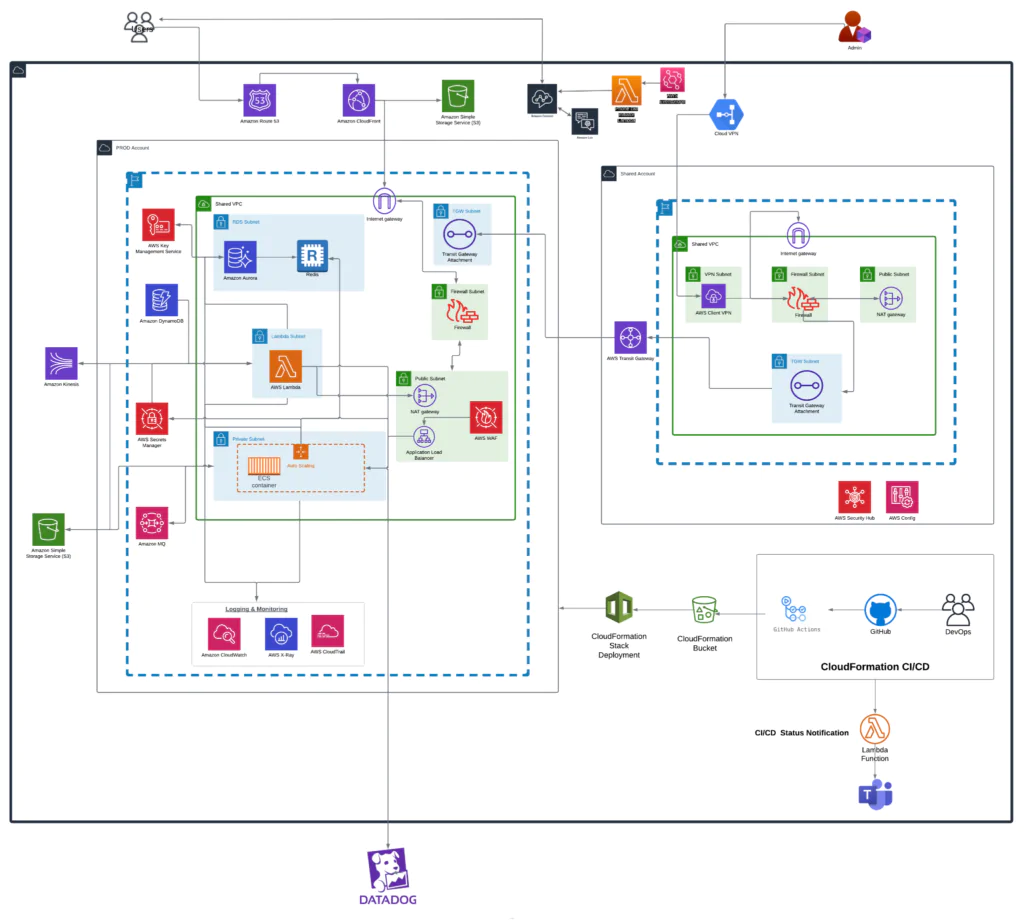
Architecture Diagram

Carsaver-resillance

AWS Services

  • Amazon DynamoDB: Our team used Amazon DynamoDB to store customer data, trade information, leads, marketing, configuration, and code.
  • Amazon CloudWatch: We used AWS CloudWatch to create alarms, monitor resource utilization metrics, and generate application logs.
  • Amazon CloudFront: We have used Cloudfront to serve static content.
  • Amazon S3 buckets: We used AWS S3 buckets to store configuration and customer data files.
  • Amazon Elastic Container Service(ECS): Our team ran all the container application services, leveraging Amazon ECS for orchestration. 
  • Elastic Load Balancing:  We leveraged AWS’s elastic load balancing as a load balancer.
  • AWS Auto Scaling: Our team used AWS autoscaling to scale up or down according to incoming traffic/load.
  • AWS ELasticache: We cached sessions and common data to reduce pressure on backend databases.
  • AWS CDK & CloudFormation: We implemented IaC(infrastructure as a code) architecture for the platform leveraging AWS CDK and CloudFormation
  • AWS ALB: Our team used AWS ALB for load balancing, ensuring high availability during peak hours and enhancing resilience.
  • AWS WAF: We use AWS WAF to protect applications against web exploits, bots, and excessive resource consumption.
  • AWS Config: Our team leverages AWS Config to track configuration history and change notifications to ensure security and governance.
  • AWS Lambda: Our team used AWS Lambda to run ETL jobs for creating prospects, marketing, nurturing, and generating deals.
  • AWS client VPN: We facilitate remote access to resources securely leveraging AWS client VPN
  • AWS network firewall: Our team actively inspects traffic flows to identify and prevent vulnerability exploits leveraging the AWS Network Firewall Intrusion Prevention System (IPS).
  • AWS SecurityHub: We use AWS Security Hub to comprehensively view AWS security posture and ensure environment configurations meet industry standards and best practices.

Related Case Studies

ONA dating - case study
Freewire - case study

Speak to our experts to unlock the value of Cloud!

Revisit consent button
How we use your personal information

We do not collect any information about users, except for the information contained in cookies. We store cookies on your device, including mobile device, as per your preferences set on our cookie consent manager. Cookies are used to make the website work as intended and to provide a more personalized web experience. By selecting ‘Required cookies only’, you are requesting Simform not to sell or share your personal information. However, you can choose to reject certain types of cookies, which may impact your experience of the website and the personalized experience we are able to offer. We use cookies to analyze the website traffic and differentiate between bots and real humans. We also disclose information about your use of our site with our social media, advertising and analytics partners. Additional details are available in our Privacy Policy.


Required cookies Always Active

These cookies are necessary for the website to function and cannot be turned off.

Optional cookies

Under the California Consumer Privacy Act, you may choose to opt-out of the optional cookies. These optional cookies include analytics cookies, performance and functionality cookies, and targeting cookies.

Analytics cookies

Analytics cookies help us understand the traffic source and user behavior, for example the pages they visit, how long they stay on a specific page, etc.

Performance cookies

Performance cookies collect information about how our website performs, for example,page responsiveness, loading times, and any technical issues encountered so that we can optimize the speed and performance of our website.

Targeting cookies

Targeting cookies enable us to build a profile of your interests and show you personalized ads. If you opt out, we will share your personal information to any third parties.