

 ChatGPT
 Perplexity
The Internet of Things (IoT) is evolving rapidly as AI becomes embedded into devices, edge platforms, and the systems that operate them. As this combination produces actionable insights, enterprises are applying AI to improve existing IoT systems and build new AI-first connected products.
Take BMW Group’s Plant Regensburg: by combining production IoT telemetry with AI-driven predictive maintenance, the team can spot failure patterns early and intervene before a line stoppage occurs. BMW reported this approach helped avoid roughly 500 minutes of production disruption per year at the plant.
With AIoT reshaping industries, let’s explore how AIoT works, its applications with real-world examples, and how to implement it.
AI for IoT: What is AIoT?
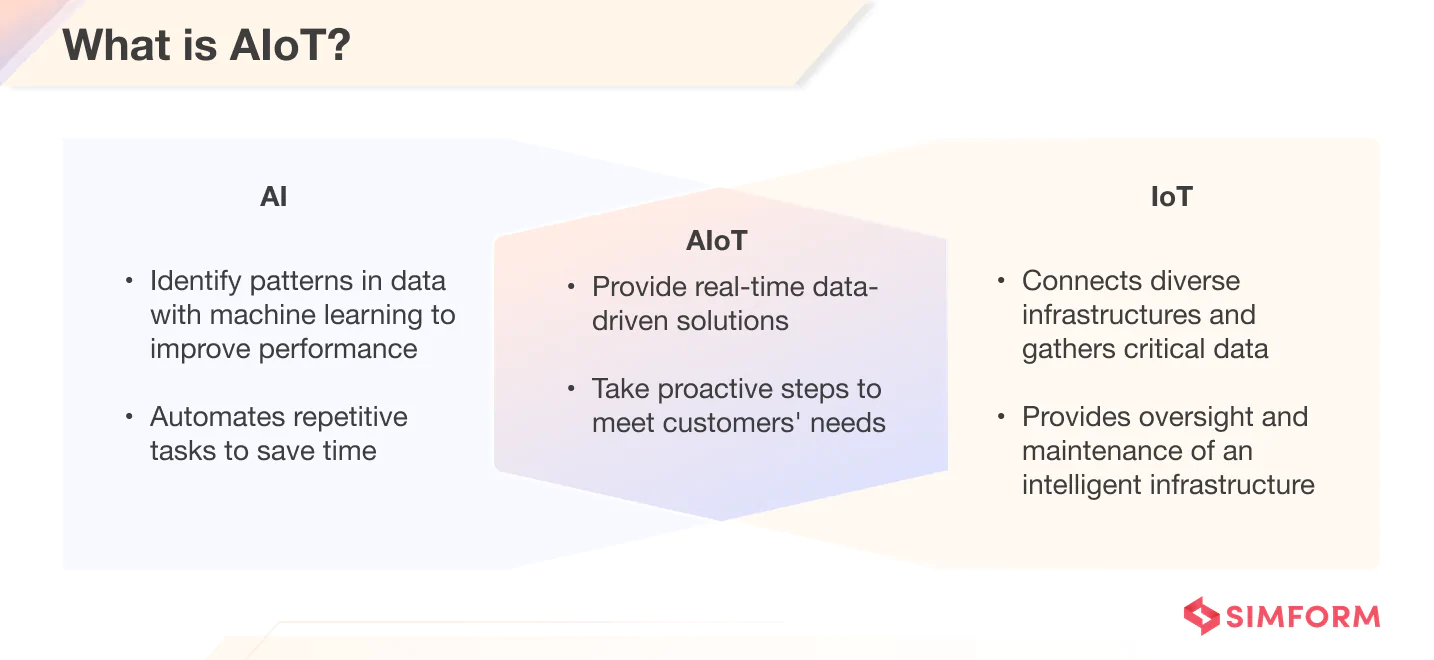
AIoT merges AI’s ability to mimic human intelligence with IoT’s connected infrastructure. It allows data to be analyzed and understood rather than simply collected and transferred. Also, it improves IoT operations, user interactions, and data analytics.
How does AIoT work?
AI adds value to IoT through machine learning and decision-making, while IoT devices add value to AI through data exchange, signaling, and connectivity. Thus, AIoT requires the connection among smart devices, software, and platforms, and it follows the outlined steps:
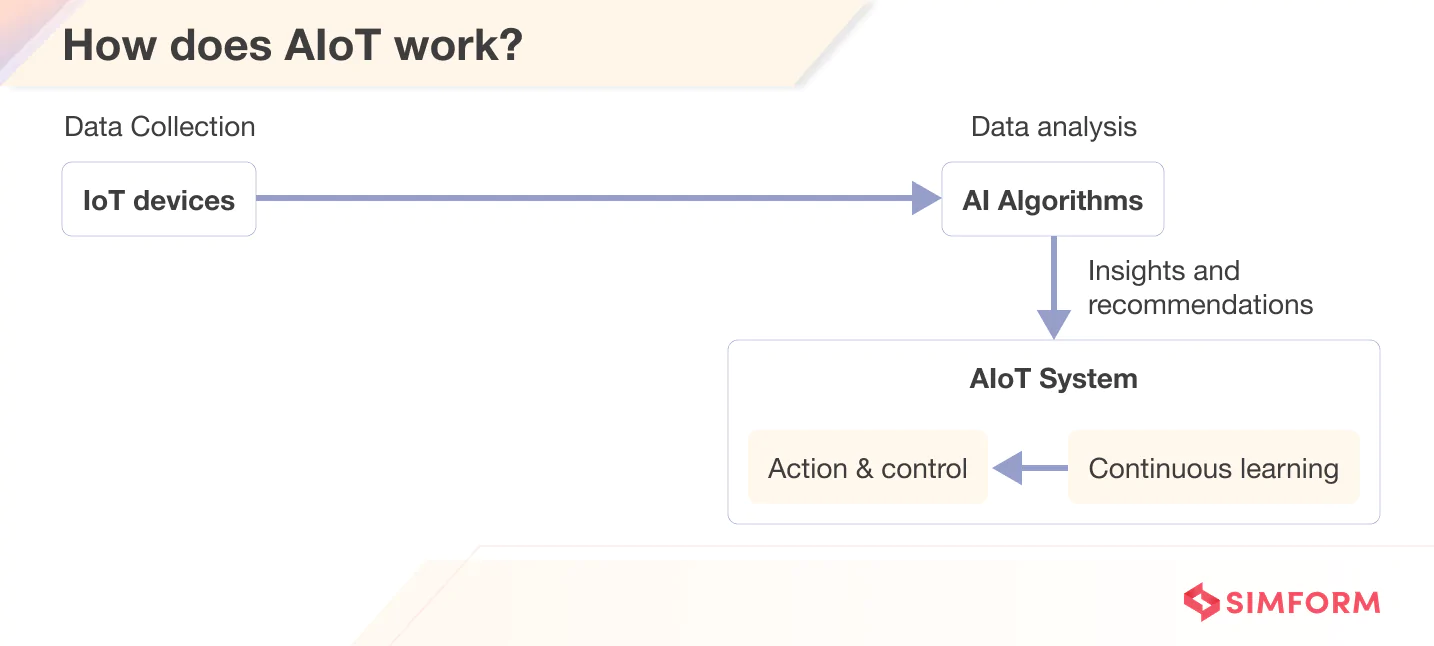
Data Collection: IoT devices, such as sensors, cameras, wearables, and industrial machines, continuously collect data and transfer it to edge gateways or cloud platforms to be processed.
Data Analysis: AI algorithms, including machine learning and deep learning, analyze the collected data to identify patterns, correlations, and anomalies. In many deployments, this analysis is split between edge (low latency) and cloud (deep training and historical learning).
Decision Making: Based on the data analysis, the AIoT system generates insights and recommendations. These recommendations enable autonomous decision-making.
Action and Control: The AIoT system triggers actions or controls connected devices in response to the insights, leading to automated responses.
Continuous Learning: AIoT systems embed continuous learning mechanisms that improve their performance over time with user interactions.
The efficiency with which AIoT functions facilitates significant benefits to organizations. Let’s explore them in detail.
Benefits of Using Artificial Intelligence in IoT
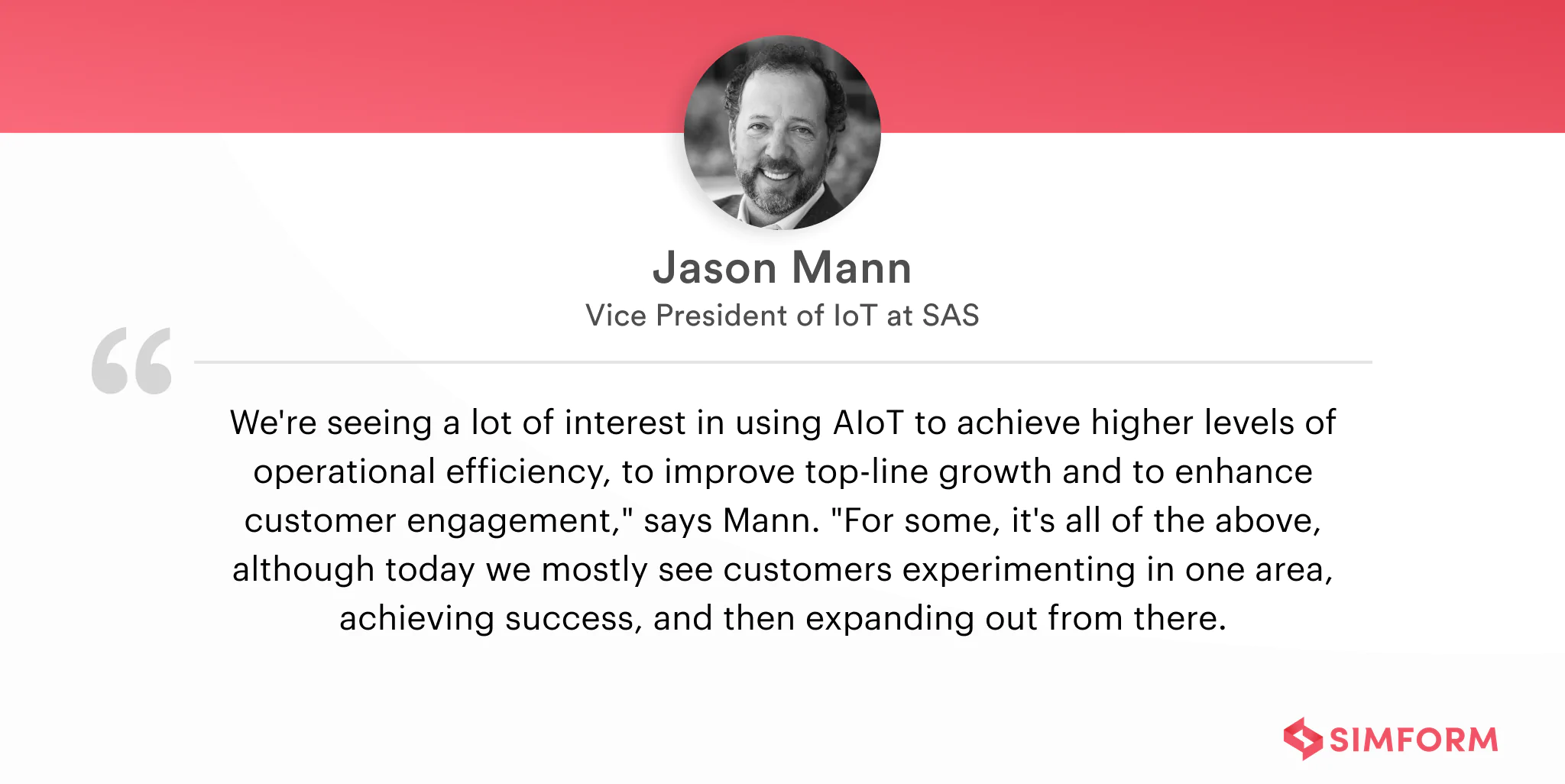
Before looking at the benefits in detail, let’s first consider the insights shared by Jason Mann, Vice President of IoT at SAS, to know why companies need AI and IoT systems. He highlights that companies focus on three objectives with their emerging AIoT capabilities.
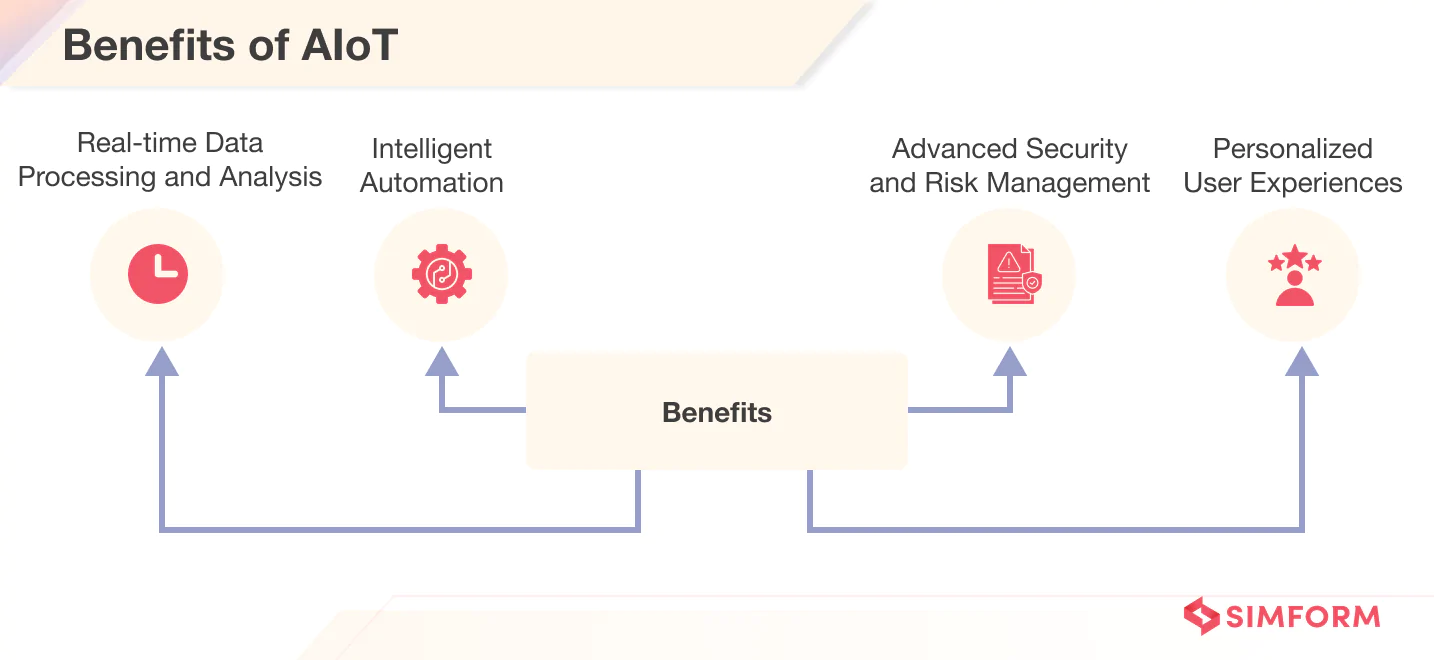
#1. Real-Time Data Processing and Analysis
The integration of AI and IoT allows for real-time analysis of data generated by internet-connected devices. This enables quicker insights and responses to events as sensor data can be processed at the edge or in the cloud as soon as it is collected.
Real-time data analysis through AIoT improves efficiency and productivity in areas like predictive maintenance, quality control, and supply chain optimization.
#2. Resource Optimization and Intelligent Automation
Artificial Intelligence of Things optimizes resource management in diverse ways. It optimizes electricity consumption by adjusting lighting, heating, and cooling systems based on occupancy and usage habits in smart homes. In industries, artificial intelligence in IoT applications can enable the predictive protection of machinery and systems.
Using AI technology in IoT also streamlines business operations by automating routine tasks. For example, an AIoT device in a warehouse can automate inventory control and order fulfillment processes. It decreases human errors and increases accuracy, quality, and productivity.
#3. Advanced Security and Risk Management
IoT networks with AI can detect strange activities and trigger actions against breaches. For example, an AIoT application can detect unusual activity captured through cameras and alert the homeowner to a possible break-in.
Security in AIoT typically depends on device identity, encryption, secure update pipelines, and continuous monitoring.
#4. Personalized User Experiences
AIoT can provide contextual applications based on users’ preferences and behavior. For instance,it can learn preferred temperature and lighting patterns and adjust settings automatically (with user control and consent). Plus, intelligent systems offer tailored recommendations by analyzing data to enhance customer satisfaction.
As AI-enabled IoT solutions bring benefits like smarter data-driven processes, improved user experience, and resource usage, they are used across many industries and verticals.
Applications of AIoT
From smart cities and transportation services to smart factories, fleet management, healthcare, and many more domains can benefit from AI and IoT integration.
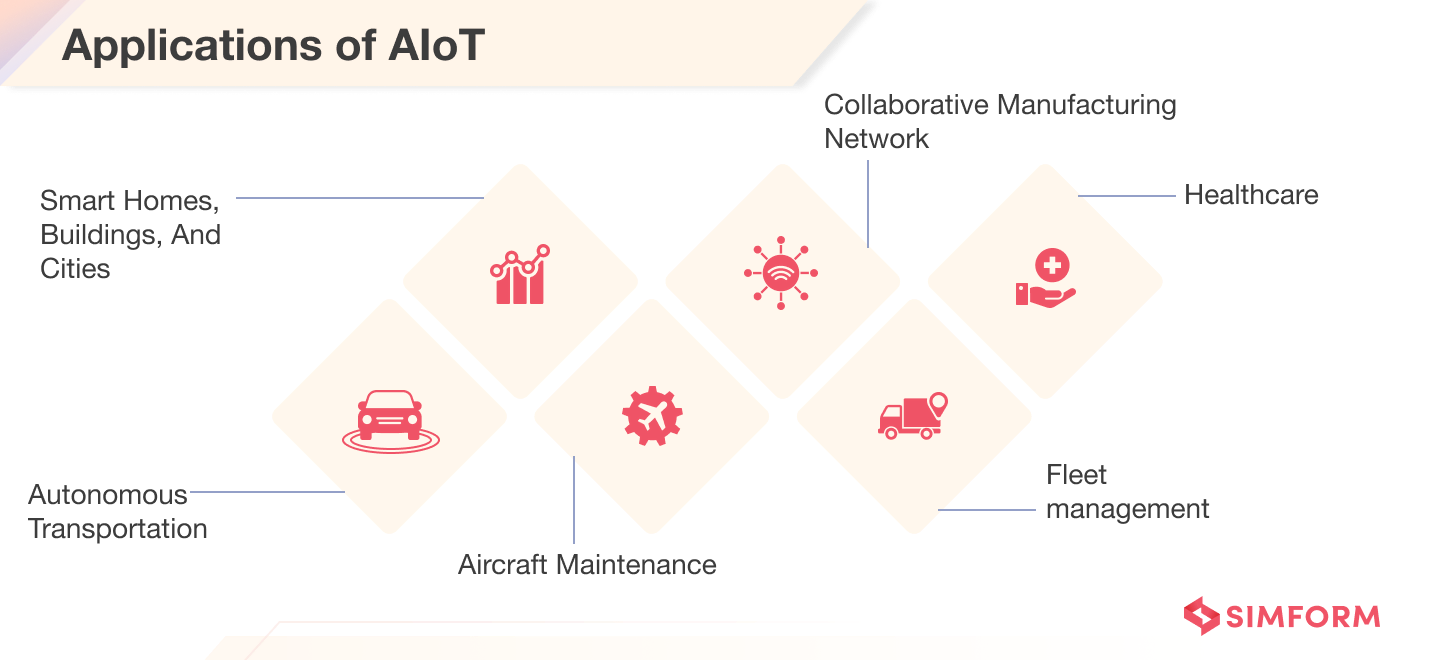
#1. Smart Homes, Buildings, and Cities
The smart home ecosystem, valued at $79.16 billion in 2022, uses AI-powered IoT devices for residents to control appliances through smartphones. Connecting AI with smart sensors of buildings enhances safety by reducing fire and flooding risks. Also, connecting AI models and automation logic with IoT devices can optimize energy efficiency and reduce operational overhead.
Moreover, AIoT applications can monitor traffic and utilize real-time data for efficient traffic management. For instance, Los Angeles uses an AI traffic management system to optimize traffic light timing by processing real-time data from road sensors. It has significantly reduced travel time by 12% and emissions by 9%.
#2. Autonomous Transportation
Automated systems can make independent decisions based on the data they collect with sensors and AI. Thus, vehicles can precisely respond to obstacles, control speed, and change direction.
Building on this progress, connected vehicle platforms continue to mature to support faster data exchange and safer decision-making across V2V and V2X environments.. Veoneer and Ericsson have formed a partnership to develop a connected vehicle cloud. This cloud technology will ensure rapid data processing, enabling autonomous vehicles to have vehicle-to-vehicle (V2V) and vehicle-to-everything (V2X) connectivity.
#3. Collaborative Manufacturing Network
Manufacturers are always innovating for safer operations. For example, in a chocolate factory, Siemens has showcased manufacturing scenarios where AI models monitor temperature, humidity, and equipment signals to detect anomalies early.
Such fusion of AI capabilities, mobile device apps, transparent data storage, and real-time analytics creates hardware independence for smart factories. AI-powered IoT solutions ensure machines operate at peak performance with predictive maintenance and autonomous fault identification to improve worker safety and operational efficiency.
#4. Aircraft Maintenance
Aircraft are equipped with sensors that track the status of various systems and subsystems to identify and predict faults. As AI is applied to the extensive data collected by these sensors, airlines can increase safety and reduce delays and downtime.
#5. Healthcare
AI-powered IoT health applications collect data to take preventive measures, detect early illness, and manage patients’ medications. This data is drawn from connected medical devices, medical records, fitness trackers, and health apps.
#6. Fleet Management And Autonomous Vehicles
In fleet management, AIoT monitors vehicles, lowers fuel expenses, tracks maintenance, and identifies unsafe driving habits. With AIoT and predictive analytics, a terminal’s capacity and outbound shipments can be better managed.
While the applications of AIoT are many, the technology comes with its fair share of challenges.
What Challenges May Arise in Implementing AI-Enabled IoT?
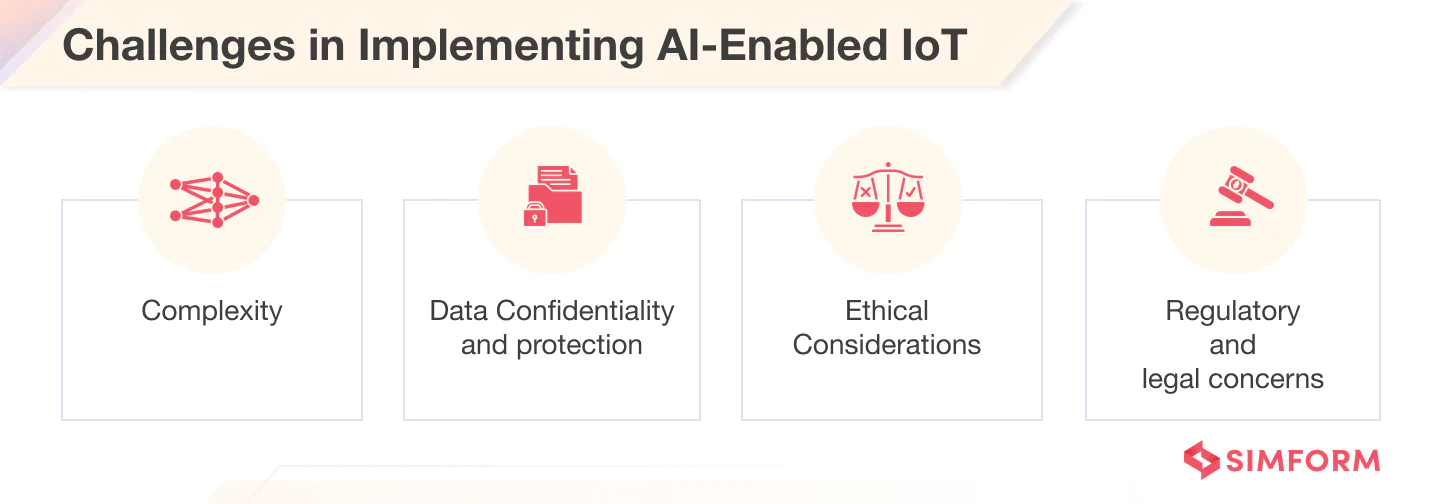
#1. Complexity
Connecting IoT infrastructure and data streams with AI algorithms is an immense integration challenge. Organizations must find ways to make different IoT devices, networks, and AI systems communicate with each other, even if they use different protocols.
There is also the complexity of managing, processing, and analyzing huge volumes of real-time data generated by countless IoT sensors and devices. Scaling up an integrated AI and IoT system across an entire operation introduces a lot of technological complexity.
#2. Data Confidentiality and Protection
AIoT systems deal with vast amounts of data from various sources, including sensors, devices, and cloud platforms. Plus, this data is transmitted between IoT devices, edge devices, the cloud, and between different components of the AIoT system. Managing and securing this diverse dataset can be challenging. Also consider model and prompt security when AI components are introduced into operational workflows.
#3. Ethical Considerations
AI algorithms in IoT devices have the potential to perpetuate biases present in the information they are trained on. In AIoT applications, biased algorithms lead to discriminatory outcomes, particularly in healthcare, finance, and law enforcement.
#4. Regulatory and Legal Concerns
Determining data ownership, consent, retention, and cross-border transfer requirements can be challenging, especially when data includes personal, location, or operational telemetry.
What Should You Consider While Combining AI with IoT?
Let’s explore the key factors to successfully integrate AI with IoT, foster innovation, and unlock new possibilities!
#1. Develop a Clear Goal
Without a proper assessment of the feasibility of ideas, organizations may get caught up in the hype of AIoT. It leads to uncontrolled costs at later stages of development, leaving stakeholders dissatisfied.
To avoid this, begin your project with a discovery phase where you test ideas against business goals, customer expectations, and organizational capabilities. It ensures that the project is aligned with the organization’s objectives and has a higher chance of success.
#2. Pick Between Edge vs. Cloud Computing Wisely
AIoT solutions can be developed using cloud, edge, or hybrid systems. You can check latency, bandwidth, and speed requirements to map out the whole solution with its cost. For time-critical systems with many devices, edge or hybrid deployment is often the practical default. Opt for cloud computing in cases where low latency and high bandwidth are less important.
#3. Ensure Security and Privacy
Many projects fail as the security of data, devices, servers, and communication networks is not taken care of in the planning phase. For projects with sensitive data, consider edge or hybrid designs where sensitive data is processed closer to the source, and only required signals are sent upstream. It minimizes the risk of compromise during transit or in the cloud. So, you can prevent costly and damaging breaches and ensure the success of the AIoT project.
#4. Create Transparency
As more teams get involved, make sure everyone has clear goals to gain the desired credibility and productivity. Maintain harmony among IoT engineering, AI developers, and data science teams. Also, combine your IT, cloud, and edge systems to get to your data, in all its aspects, at all times.
Getting Started with AIoT
AIoT projects need solid engineering around data pipelines, edge reliability, model lifecycle management, and production monitoring. This is where an expert AI/ML solutions provider like Simform can change the game for you!
Our AI/ML experts and IoT specialists can build the right infrastructure for different AIoT use cases. Moreover, from strategy development to designing an efficient IoT network with AI algorithms for advanced data analytics, our consultants will guide you through every step of the process.
If you are not sure whether to or how to leverage the artificial intelligence of things for your organization, Contact us for a free consultation with our AIoT experts.


