

Generative AI continues to dominate boardroom conversations, but there’s a sobering reality beneath the hype: most enterprises struggle to apply GenAI to their own data in a reliable, secure, or scalable way.
This became especially clear during a recent webinar Simform hosted in partnership with Microsoft on “Modernizing data warehouses with AI”. One statistic set the tone immediately:
63% of Chief Data Officers say they lack the data foundation required to successfully adopt generative AI.
While organizations must modernize their data architecture to support advanced AI use cases, the modernization process itself is being transformed by AI-driven approaches.
This article distills the biggest webinar insights, real lessons from modernizing data warehouses, and how Simform’s TruMorph accelerator on Microsoft Fabric uses AI to help enterprises become truly AI-ready.
The truth: AI needs more than just data
AI needs intelligent, governable, production-ready data. But most enterprise data architectures were designed for yesterday’s analytics, such as dashboards, BI reports, and monthly reviews.They cannot cater to:
- real-time predictions
- retrieval-augmented generation (RAG)
- automated decisioning
- continuous feature engineering
- LLM-driven analytics
Thus, these challenges appear in most data modernization projects.
Common enterprise bottlenecks
- Data spread across disconnected on-prem systems, SaaS tools, and cloud stores
- Fragile ETLs that break on every schema drift
- Manual PII/PHI masking and inconsistent governance
- Poor lineage and lack of traceability
- High MTTR (Mean Time to Repair) for pipeline incidents
- Teams debating metrics because “numbers don’t match”
- A culture of “Don’t touch that pipeline.”
You cannot build trustworthy AI on top of untrustworthy data.
And you definitely cannot scale AI if your pipelines break under the weight of everyday operational data.
The four pillars of an AI-ready data foundation
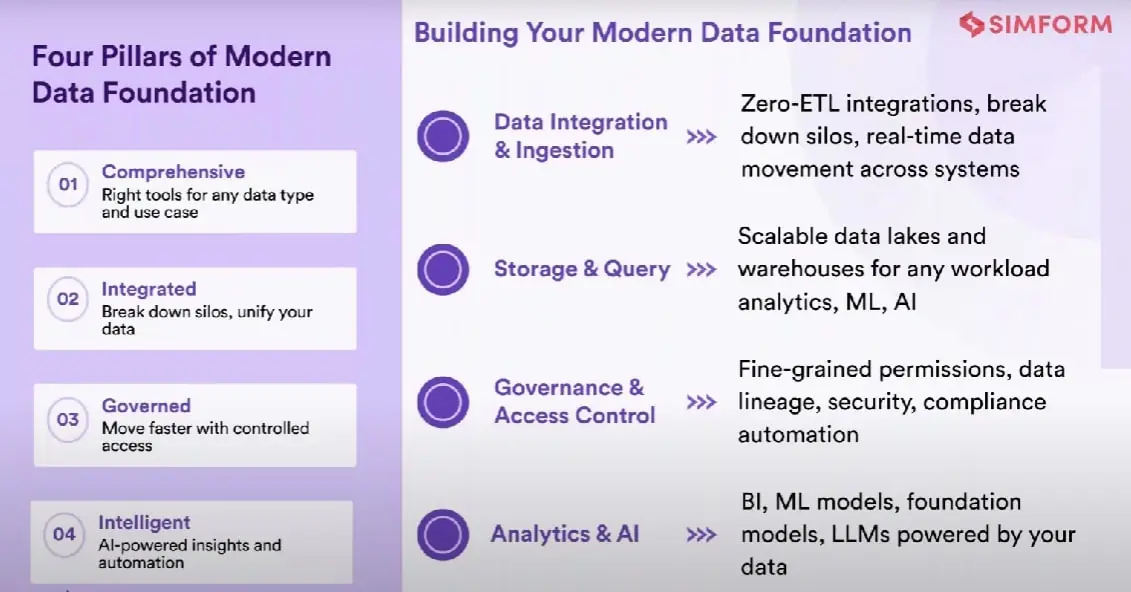
Enterprises that successfully adopt GenAI treat data modernization not as “migration” but as strategic reinvention. Based on our work and the webinar discussion, an AI-ready foundation rests on four essential pillars:
1. Comprehensive: Support for any data type, structure, and source, meaning, ready for ingestion at high velocity and scale.
2. Integrated: Unified data across clouds, apps, operational systems, sensors, and third-party platforms.
3. Governed: Security, masking, permissions, audit trails, and policies applied automatically, not manually.
4. Intelligent: AI used to improve the data itself: quality checks, anomaly detection, lineage creation, and transformation logic.
How these pillars show up in your day-to-day operations:
Companies like United Airlines, AstraZeneca, and Samsung are already applying these principles to generate millions in savings through real-time insights, accelerated discovery, and automated operations.
What we learned from modernizing data environments using AI
Across our multiple modernization engagements, a few patterns consistently deliver outsized impact:
1. Self-healing pipelines are essential
Schema drift, null explosions, type mismatches– these are no longer “edge cases.” They’re daily realities in enterprise systems. AI-assisted pipeline logic dramatically reduces MTTR (Mean Time to Repair) by resolving issues before they break dashboards or downstream models.
2. Profiling + LLMs leads to proactive data quality
LLMs analyzing data profiles can auto-generate rules for:
- anomaly detection
- missingness handling
- schema alignment
- inferable business logic
Data owners simply review → approve → reuse.
3. Human-in-the-loop is critical for trust
Full automation is powerful, but sensitive transformations still require controlled approvals. Blending in verification reduces risk and builds trust across engineering, governance, and compliance teams.
4. Predictive orchestration reduces cost and increases freshness
By forecasting when source data is likely to arrive, pipelines can trigger intelligently, ensuring near real-time data without unnecessary compute spend.
5. AI readiness becomes a business KPI
Tracking the “AI readiness” of each layer (bronze → silver → gold) gives enterprises a tangible KPI to evaluate progress and prioritize remediation.
“AI readiness is not a status. It’s a score that improves with every modernization cycle.”
– Matthew Wendel, Principal Solutions Consultant, Simform
This set of lessons became the backbone of Simform’s approaches, and ultimately shaped the architecture of our AI-powered accelerator, TruMorph.
TruMorph: AI accelerator for data warehouse modernization
During the session, we shared a behind-the-scenes look at our TruMorph accelerator to demonstrate what actually changes when AI becomes part of the modernization workflow.
- AI-driven data profiling surfaced issues long before they reached dashboards, helping teams shift from reactive firefighting to proactive quality control.
- Human-in-the-loop approvals, built directly into collaboration tools, showed how organizations can balance automation with governance without slowing delivery.
- Self-healing transformations corrected schema drift and data inconsistencies automatically, reducing the operational burden teams face daily.
- And perhaps most importantly, AI-readiness scoring provided a measurable indicator of how close each dataset is to supporting LLM and ML workloads.
TruMorph follows the canonical Bronze → Silver → Gold lakehouse flow, but with AI and governance embedded at every stage—giving enterprises a resilient, continuously improving foundation for AI adoption.
Check out the full webinar here for a deeper dive!
How IFS accelerated analytics by 300% with Microsoft Fabric
IFS, a global enterprise software provider, was running on a fragmented analytics stack with overlapping services and limited visibility. By consolidating onto Microsoft Fabric and modernizing their data foundation, IFS achieved:
- >300% increase in analytics insights
- >80% improvement in integration & data access
- >200% faster launch of new data products
This shift wasn’t just technical. It enabled IFS teams across the business to collaborate better, accelerate decision-making, and deliver data-driven innovation at scale, demonstrating the real-world impact of modernizing for AI readiness.
Build AI-ready data foundation with Simform
No enterprise can unlock the full potential of generative AI without first strengthening the systems that feed it. Models will continue to evolve rapidly, but without clean, governed, unified, and intelligent data behind them, AI initiatives stall before they start.
Modernization has now become a strategic prerequisite for building AI-driven organizations. Enterprises that invest in it today position themselves to move faster, deliver better customer experiences, and innovate with confidence.
Take the first step by evaluating your current data foundation and where your foundation may fall short. And if you’re ready to accelerate that journey, let’s do it together.


