

Modernizing legacy systems is one of those projects every enterprise knows it needs, yet few feel confident about funding. Multi-year timelines, uncertain ROI, and outage risks make it easy to push to “next year.”
What makes it even harder to fund is technical debt. It accounts for roughly 40% of the technology estate, diverting 10–20% of budgets that could be used for new products and capabilities.
But technical debt is only a symptom. The deeper issue is coordination complexity. Most enterprises now run 200+ applications with interconnected data flows, shared services, and compliance requirements.
Every change risks breaking something else, making modernization unpredictable and expensive. Agentic AI changes that.
These autonomous systems can independently set goals, plan multi-step approaches, and execute coordinated changes across interconnected enterprise systems. They adapt to unexpected conditions and learn from each interaction.
If done right, modernization becomes faster, supervised, and fundable.
What makes agentic AI different for modernization?
Unlike conventional tools, AI agents combine autonomous reasoning with strict operational guardrails. They can assess complex enterprise environments, choose appropriate remediation strategies, adapt to changing conditions, and coordinate across multiple domains. Throughout this process, they operate within your security policies, compliance frameworks, and budget constraints.
Gartner predicts that by 2026, 40% of enterprise applications will include task-specific AI agents, up from less than 5% today. For modernization specifically, this means the tools enterprises use to manage transformation are becoming agent-native, not just agent-compatible.
Key agentic AI capabilities for modernization:
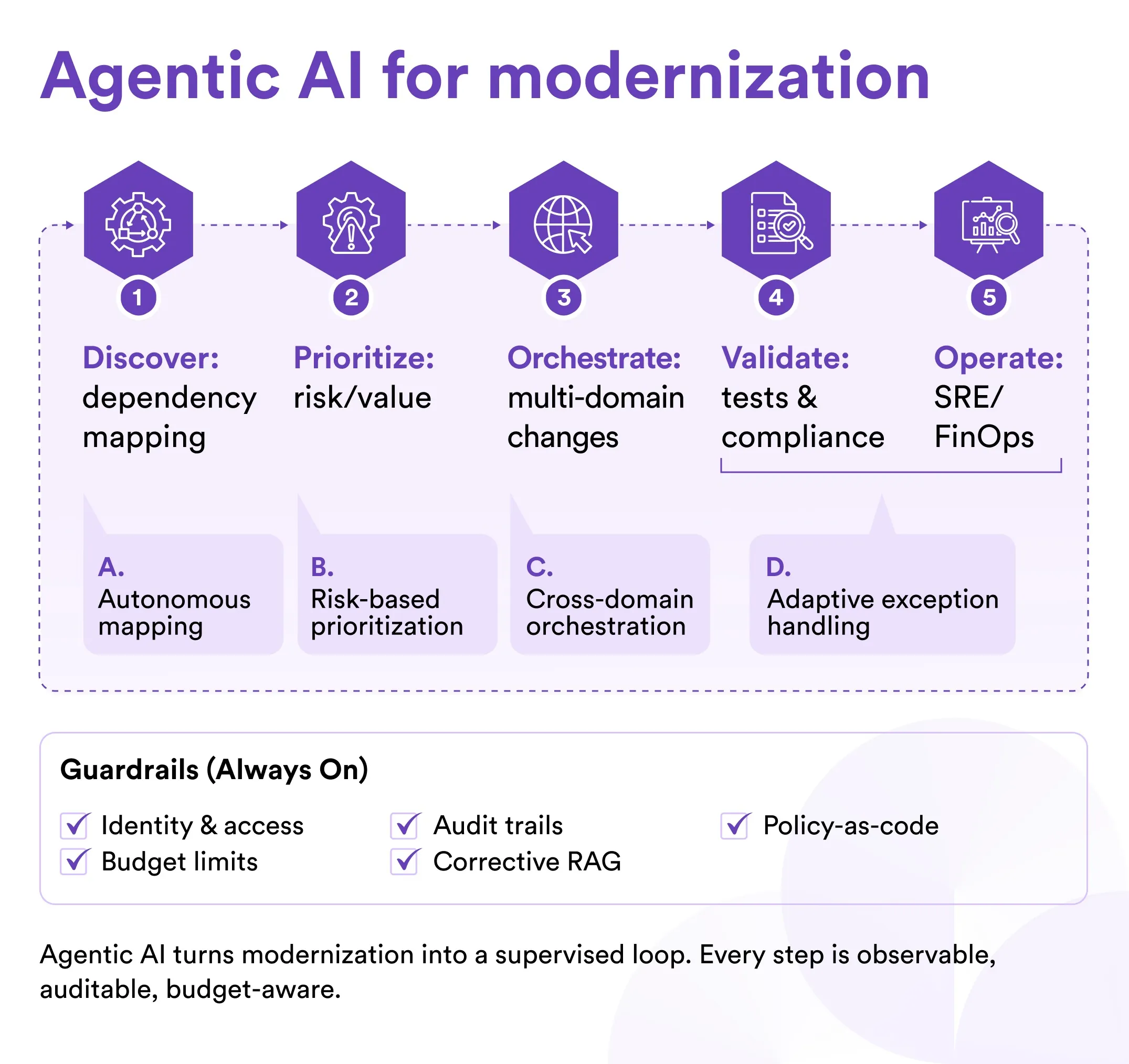
Autonomous dependency mapping and sequencing – First, AI agents scan your entire application and data estate to understand how changes to core systems cascade. They track impacts through customer portals, analytics dashboards, and partner integrations. The agents then sequence updates to prevent downstream failures while optimizing for business continuity.
Cross-domain orchestration – AI agents coordinate application updates with infrastructure provisioning and data pipeline migrations as unified workstreams. This coordination eliminates the handoff delays that typically extend enterprise projects by months. It also ensures data flows remain reliable throughout modernization.
Risk-based prioritization with data modernization integration – Unlike traditional approaches, AI agents don’t follow arbitrary modernization phases. They analyze which systems pose the highest operational risk or deliver the greatest business value when updated.
The agents simultaneously ensure that data governance requirements are met. They update data validation rules, schema changes, and analytics feeds to prevent downstream business intelligence failures.
Adaptive exception handling – When legacy systems respond differently than expected during modernization, AI agents adjust the approach in real-time. They handle issues autonomously without escalating every problem to human operators. The agents maintain context about business requirements and technical constraints to make informed decisions about alternative pathways.
Microsoft’s multi-agent architecture demonstrates this in action
Microsoft’s Azure AI Foundry reference architecture shows these capabilities working together in practice. The system uses specialized agents within an orchestrated framework.
Triage agents analyze complex modernization requests and break them into coordinated tasks. Coordinator agents then sequence interdependent workflows across different domains.
Meanwhile, specialized agents perform specific functions, such as document verification and compliance validation. The entire process maintains governance controls throughout each step.
Microsoft has been shipping production capabilities to support this architecture. In December 2025 and January 2026, Microsoft Foundry added managed long-term memory for agents, enabling context retention across sessions.
It also introduced an Agent-to-Agent (A2A) tool that allows Foundry agents to call external A2A-protocol endpoints with structured authentication, and a cloud-hosted MCP server for secure, zero-setup agent connectivity.
For legacy code modernization specifically, GPT-5.1 Codex Max became generally available with a 400K token context window and support for multi-agent coding pipelines, including refactoring .NET and Java applications.
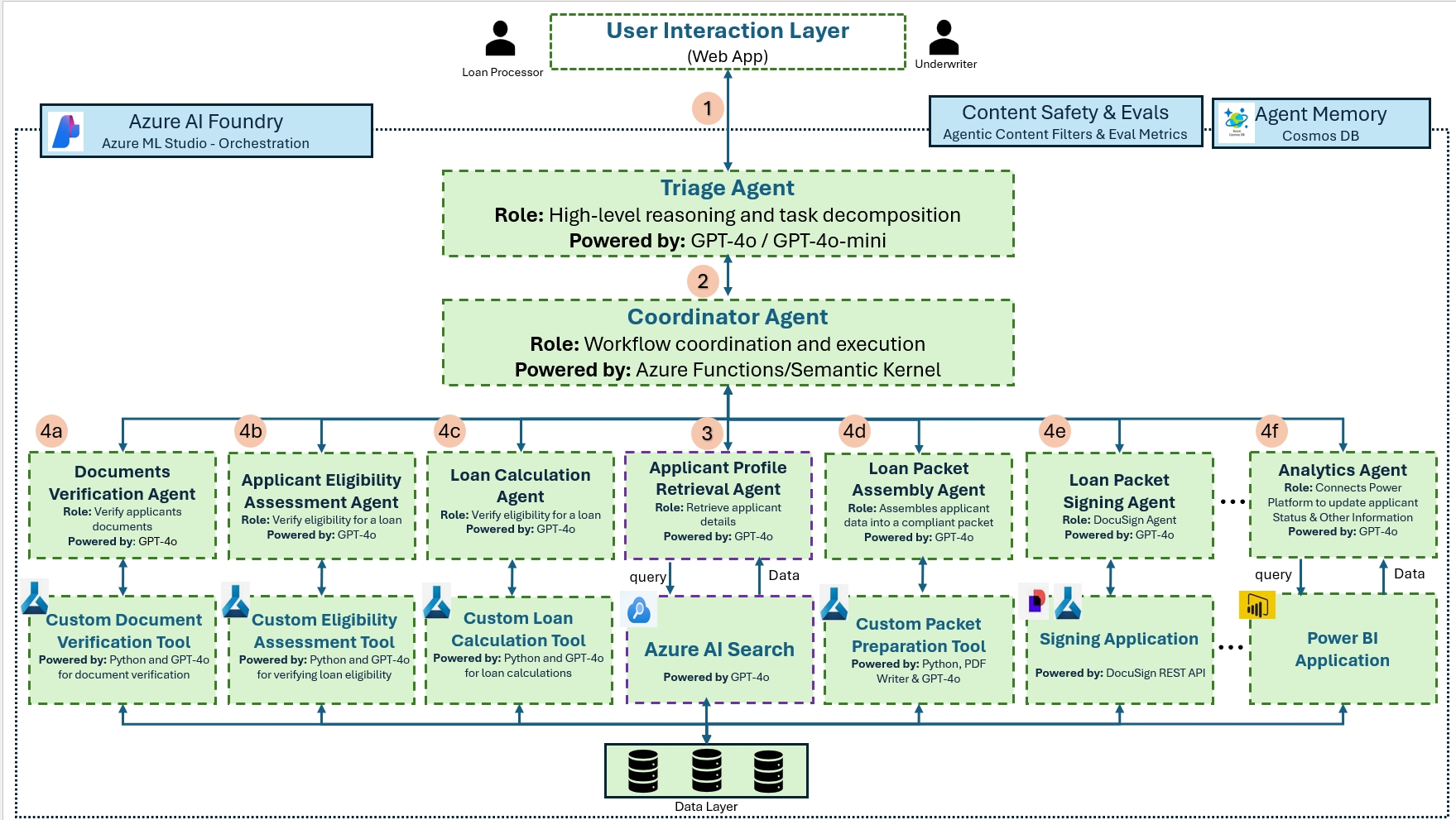
The architecture addresses the coordination challenge that traditionally requires 30-60 days of manual handoffs between underwriters, compliance teams, and processors.
How to modernize with Agentic AI
Agentic AI can automate the complex decision-making required to coordinate changes across your interconnected enterprise systems. The key to successful modernization lies in deploying specialized agents for specific modernization challenges.
Fortunately, you don’t need to modernize everything at once. Identify and deploy different AI agents for different parts of your modernization journey. Each agent focuses on what it does best while working together toward your business goals.
By deploying purpose-built agents for each domain, you gain the precision and depth needed to handle enterprise-scale modernization safely and efficiently.
Legacy application modernization
You have applications built on outdated frameworks that are expensive to maintain and impossible to extend with modern capabilities. Manual modernization takes months per application and carries a risk of breaking business-critical functionality.
The agentic AI solution
To begin, configure AI agents with your team’s expertise through structured prompts and business context. Next, teams fine-tune agents to adapt to specific coding styles and provide business-specific acronyms and documentation. They also encode validation criteria and deployment processes into reusable workflows.
The AI agents then execute these configured workflows. One agent focuses on code analysis and rewriting using your development standards. Another applies quality validation rules from your QA processes, while a third handles building and runtime testing based on your DevOps practices.
Case in point
Visma, a €2 billion fintech company with 400+ SaaS products, used this approach to modernize Flex HRM, a 3 million line .NET application with 30 developers.
The specialized agent approach, combined with Microsoft’s .NET upgrade assistant and GitHub Copilot, delivered a 40% reduction in human effort and €600,000 in annual cost savings.
The development team went from 0% to 100% AI adoption practically overnight because they could see exactly what each agent was doing and maintain control over the process.
Simform’s accelerators role
NeuVantage accelerates modernization by performing AI-powered technology portfolio analysis and mapping transformation paths using the 5R strategy.
The platform generates automated application inventories and breaks complex codebases into logical chunks for analysis. It then delivers cloud-ready modernization blueprints that can accelerate application modernization by up to 40%.
CodeTools provides structured AI automation across the entire development lifecycle. The platform includes a curated prompt library that standardizes common developer tasks like generating test cases and documentation, eliminating trial-and-error prompt crafting. CodeTools also extends GitHub Copilot with custom capabilities for consistent pull request reviews, automated quality checks, and Infrastructure-as-Code workflows. Rather than developers learning AI tools in isolation, CodeTools creates an integrated automation foundation that enforces quality standards while reducing delivery costs and improving cycle times.
Data platform modernization
Your data is scattered across disconnected systems, creating static dashboards that can’t deliver actionable insights fast enough. Traditional data platforms are inflexible and costly—requiring months to adapt when marketing teams need new customer insights or sales teams need real-time pipeline data.
Heavy engineering effort is required just to integrate new CRMs or data streams, while sensitive data flows into places it shouldn’t. Teams struggle to access, organize, and extract value from data that’s both deep and widespread across your enterprise.
Anthropic’s survey of 500+ technical leaders found that 46% cite integration with existing systems as the biggest barrier to scaling AI agents, while 42% point to data access and quality.
The agentic AI solution
Deploy specialized agents within a structured framework that combines automation with human oversight. Agents assist with data discovery and relationship mapping using pre-configured governance rules.
They automate routine data validation checks based on established compliance processes. Agents also optimize pipeline monitoring through AI-driven insights while requiring human validation for critical decisions.
This hybrid model reduces manual effort in routine tasks while maintaining the governance controls enterprise data management requires.
Case in point
NTT DATA, a global business and technology services provider earning $30 billion annually faced exactly these challenges with data spread across deep and widespread systems.
Using Microsoft Fabric data agents and Azure AI Agent Service, they moved beyond static dashboards to conversational agents that deliver role-specific insights in natural language.
Their HR operations agents now analyze workforce labor data in real-time, uncovering patterns in staffing and productivity that manual reporting missed.
The result was a 50% faster time-to-market for data solutions and improved productivity across HR, sales, and marketing functions. Teams no longer have to wait months for a dashboard change. They can now ask personalized questions and get actionable insights immediately.
Simform’s accelerators role
Data360 provides a composable customer data infrastructure with modular components that can be customized independently without disrupting the entire stack. The platform features built-in data governance layers, flexible customer profiling capabilities, and AI-powered conversational interfaces that enable teams to interact with data in natural language.
ThoughtMesh enables agents to operate on trusted enterprise knowledge through its agent management and orchestration framework. The platform provides no-code workflow builders, namespace-driven security controls, and corrective RAG systems that minimize hallucinations.
It transforms enterprise data into AI-ready formats through vectorization pipelines and knowledge management infrastructure, ensuring agents have access to the right information with proper security controls in place.
Infrastructure and security modernization
Your underlying architecture may run modernized applications, but if the infrastructure foundation is weak, you inherit the same fragility at a higher cost. You need to build secure, observable, and resilient infrastructure in a repeatable manner.
The agentic AI solution
Infrastructure AI agents assist with generating infrastructure-as-code templates while requiring expert validation and customization for complex environments.
Security architecture agents help model resiliency patterns and identify anti-patterns, such as single points of failure. They suggest zero-trust configurations, but implementation typically requires specialist oversight and staged rollouts to ensure enterprise compliance.
Case in point
Cognition’s deployment of their Devin AI agent required enterprise-grade infrastructure that could scale across large organizations. Working with Microsoft Azure, they used infrastructure agents to assist with environment provisioning while security architecture agents supported compliance with enterprise security requirements.
The result was a 50% reduction in project costs and the ability to scale Devin across enterprise customers like Visma with confidence.
Simform’s accelerators role
Our AI-WAFR Bot automates well-architected framework reviews by analyzing Terraform configurations against Azure’s WAF best practices in minutes rather than days.
Powered by Azure OpenAI, the bot detects misconfigurations, security gaps, and performance inefficiencies while generating context-aware fixes.
The system provides comprehensive JSON reports with risk levels, remediation suggestions, and integrates directly into CI/CD pipelines for continuous compliance checking. An integrated Terraform Assistant offers real-time conversational support for code improvements.
Operations and continuous optimization
Once your applications and data are modernized, you need them to run reliably in production with fast recovery when issues occur. Manual monitoring and incident response create operational delays that limit the business value of your modernization investment.
The agentic AI solution
Agentic AI operational solutions leverage specialized autonomous agents embedded within platforms like Azure Monitor, Google FinOps Hub, Databricks, and Acceldata.
- SRE agents (Azure) automate incident detection and resolution, reducing manual intervention and enabling real-time remediation.
- For cost optimization, FinOps agents continually analyze cloud unit economics and optimize costs, triggering actions to align budgets and scheduling with actual usage.
- Finally, data reliability agents autonomously maintain pipeline health, validate schemas, and detect data drift, delivering robust, resilient operations whether on Azure or hybrid architectures.
Case in point
A global manufacturing company with complex factory management applications faced operational bottlenecks from manual incident response processes that often took hours to resolve, impacting production schedules and customer deliveries.
The organization deployed SRE Agents across its modernized factory management systems to automate routine operational tasks. The agents compressed incident response time from hours to minutes, automatically handling 70% of operational issues without human intervention. FinOps agents identified $2M in annual cost savings by optimizing resource scheduling based on actual usage patterns rather than peak capacity planning.
How Simform accelerates your agentic modernization
When you deploy AI agents at enterprise scale, you face three critical governance challenges. Your security teams need granular access controls that prevent agents from overstepping system boundaries. Compliance officers require audit trails that demonstrate AI decisions meet regulatory standards. Your engineering leaders must eliminate hallucination risks that could corrupt business logic in production systems.
Successful agentic modernization requires a governance architecture that scales with AI capabilities. As an enterprise leader, you achieve measurable outcomes by embedding control frameworks directly into agent workflows rather than retrofitting oversight after deployment.
Simform’s accelerators address these concerns directly:
NeuVantage provides agents with verified architectural intelligence rather than relying on assumptions. Accurate codebase mapping and dependency analysis prevent the hallucination-driven errors that could disrupt critical business functions.
CodeTools embeds your development expertise into structured agent workflows. Automated quality reviews and compliance validation happen within the development process.
Data360 delivers composable data governance that scales with agent operations. Built-in compliance layers and modular access controls ensure agents operate within authorized data boundaries while maintaining operational velocity.
ThoughtMesh addresses enterprise knowledge security through namespace-driven access controls. Corrective RAG validation against trusted sources minimizes hallucinations and ensures agents access only authorized information.
AI-WAFR Bot validates infrastructure changes against enterprise governance requirements before deployment. Automated compliance checking delivers the audit documentation required by regulatory frameworks.
These accelerators deliver governed modernization that CIOs can fund with confidence—predictable outcomes, controlled risks, and scalable deployment of expertise across enterprise application portfolios.


