
Real bricks: Making high-quality real estate investing accessible to everyone.
Category: Real Estate. eCommerce
Services: DevOps, Cloud Architecture Design and Review.
Category: Real Estate. eCommerce
Services: DevOps, Cloud Architecture Design and Review.
Problem 1: Infrastructure Management
The client faced difficulty in creating and managing four environments, namely Dev, UAT, Stage, and Production, with AWS console. This process consumed a lot of time and resources, leading to inefficiencies.
Problem 2: Limited Functionality of Lambda for Cron Job
The client’s cron job involved creating statements and sending them via email to all users on a specific date of every month. However, using Lambda for this task posed a problem as it can only run for 15 minutes. With a vast client database, this functionality would take more time, potentially creating future problems.
Solution 1
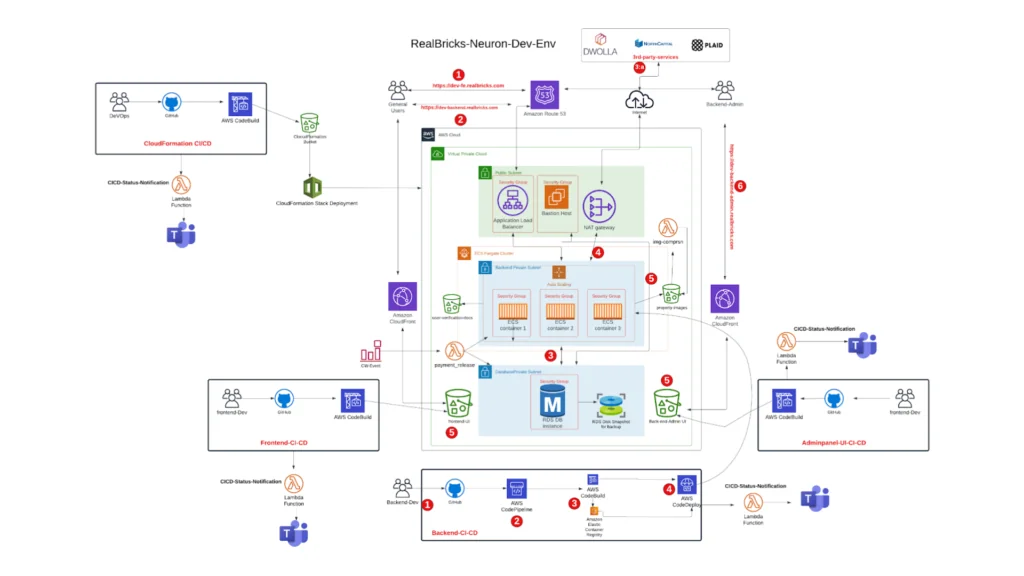
To address the client’s infrastructure management problem, we proposed using AWS CloudFormation infrastructure as code. This solution enabled us to create a new environment within two-three hours, significantly reducing the deployment time for large infrastructure projects. Additionally, we implemented a seamless CI/CD pipeline for fast and efficient infrastructure deployment.
Solution 2
To resolve the issue of time-consuming cron jobs, we recommended using an ECS scheduled task triggered by an EventBridge rule. This solution allowed us to create statements and send them via email to thousands of users every month without any issue. We also suggested deploying the client’s backend APIs using ECS Fargate service, which can spawn new containers quickly in the event of failure and scale up or down based on traffic load, providing efficient and cost-effective management of resources.


We do not collect any information about users, except for the information contained in cookies. We store cookies on your device, including mobile device, as per your preferences set on our cookie consent manager. Cookies are used to make the website work as intended and to provide a more personalized web experience. By selecting ‘Required cookies only’, you are requesting Simform not to sell or share your personal information. However, you can choose to reject certain types of cookies, which may impact your experience of the website and the personalized experience we are able to offer. We use cookies to analyze the website traffic and differentiate between bots and real humans. We also disclose information about your use of our site with our social media, advertising and analytics partners. Additional details are available in our Privacy Policy.
These cookies are necessary for the website to function and cannot be turned off.
Under the California Consumer Privacy Act, you may choose to opt-out of the optional cookies. These optional cookies include analytics cookies, performance and functionality cookies, and targeting cookies.
Analytics cookies help us understand the traffic source and user behavior, for example the pages they visit, how long they stay on a specific page, etc.
Performance cookies collect information about how our website performs, for example,page responsiveness, loading times, and any technical issues encountered so that we can optimize the speed and performance of our website.
Targeting cookies enable us to build a profile of your interests and show you personalized ads. If you opt out, we will share your personal information to any third parties.