

 ChatGPT
 Perplexity
Most programmers choose a backend technology for their web app development projects based on their training or fluency in a particular technology. While this might be convenient, it’s often not the right approach to get the desired results for businesses. The programming language, environment, and the entire tech stack need to be chosen according to the nature of the project.
Moreover, using the right backend technology in conjunction with the project’s use-case is imperative. It determines the performance, resource consumption, ease of deployment, scalability, and sometimes even the very success of the project.
Between Node.js vs Python, both are widely used server-side technologies even though both of them were developed on different timelines and designed for different objectives. Python has been around since 1991.
It was designed as a server-side programming language that could be ideally deployed for mobile and web applications. In contrast, Node.js was introduced in 2009 as a JavaScript runtime environment that revolutionized the use of JavaScript on the server-side.
As a CTO or an app owner, you might wonder which one to choose for your project. So to make the right call, it’s essential to study their advantages & limitations and follow use cases where one would outdo the other and vice versa.
Editor’s note: if you want to implement it for your project and take it further, feel free to consider Simform’s web application development services to get your project started.
Node.js vs Python: Overview
The key difference between Node.js vs Python is that the former is a runtime environment primarily dependent on Javascript. It’s used for applications that frequently interact with web servers and designed for optimal computing-resource utilization.
Node.js is used to develop frontend and backend with a single unified stack, while Python is used for complex web projects like big data, AI development, automation,and backend.
What is Node.js?
Since Node.js is event-driven, it’s scalable and brings phenomenal efficiencies to the project. Its asynchronous nature equips it to handle concurrent requests without blocking the I/O operations. Most development teams prefer Node.js to use JavaScript on both clients and server-side.
What is Python?
On the flip side, Python is a full-fledged, high-level, and object-oriented programming language. Since it’s been around for close to 30 years, it has a ton of libraries, APIs, and ancillary tools available. Python is conducive to several programming paradigms, and it’s extensively used for business applications.
Its community, libraries, and supporting platforms are far reaching. Hence, it is an ideal programming language for most businesses that are required to develop applications for different and often uncorrelated use cases.
Node.js vs Python: Which one is more popular?
Source
The popularity of a backend technology plays a critical role in whether it’ll be used for your project.
First off from the company’s perspective, the development team has to decide which language has a significant degree of talent available in the market. And then from the POV of programmers, a decision has to be reached whether they are willing to pick up languages that are predominantly used by many companies.
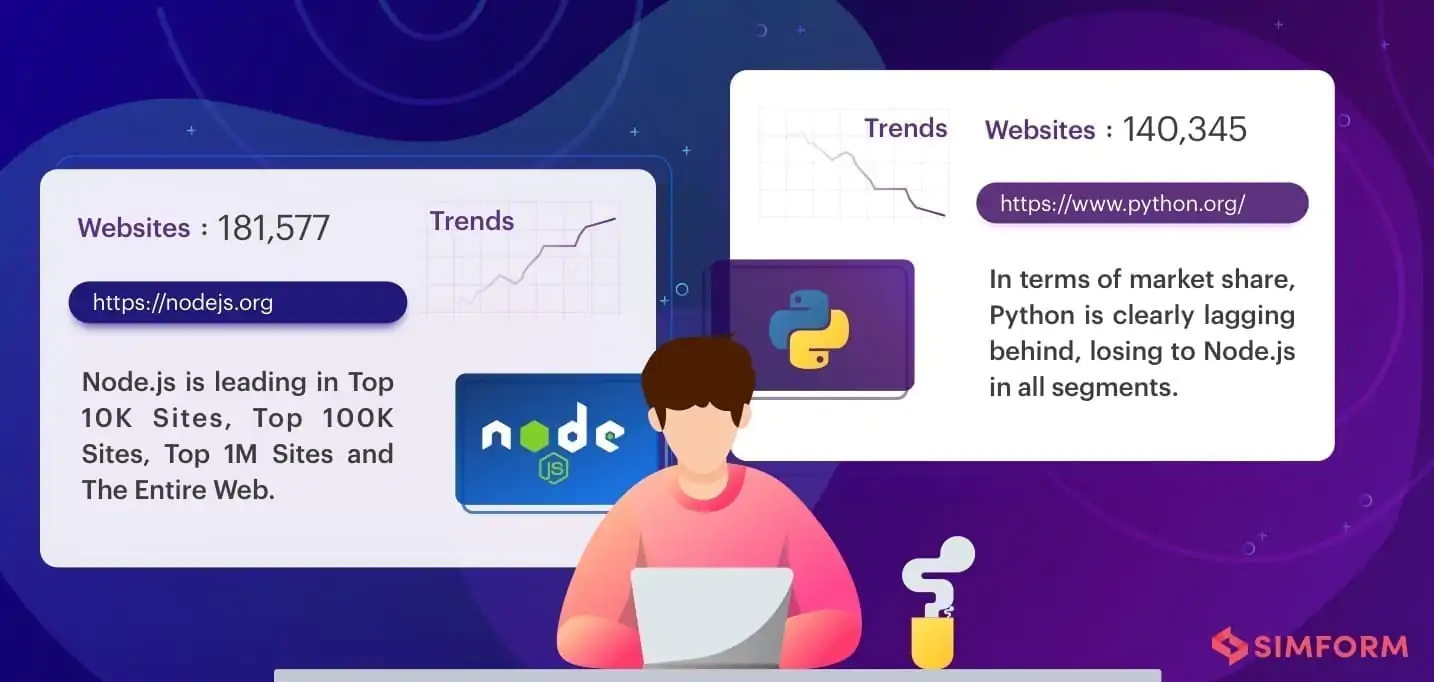
Looking at the popularity of websites, SimilarWeb reported that Node.js was credited to be the most used tool in the first 10,000, 100,000, 1,000,000, and the ‘entire’ categories of websites ranked on their popularity.
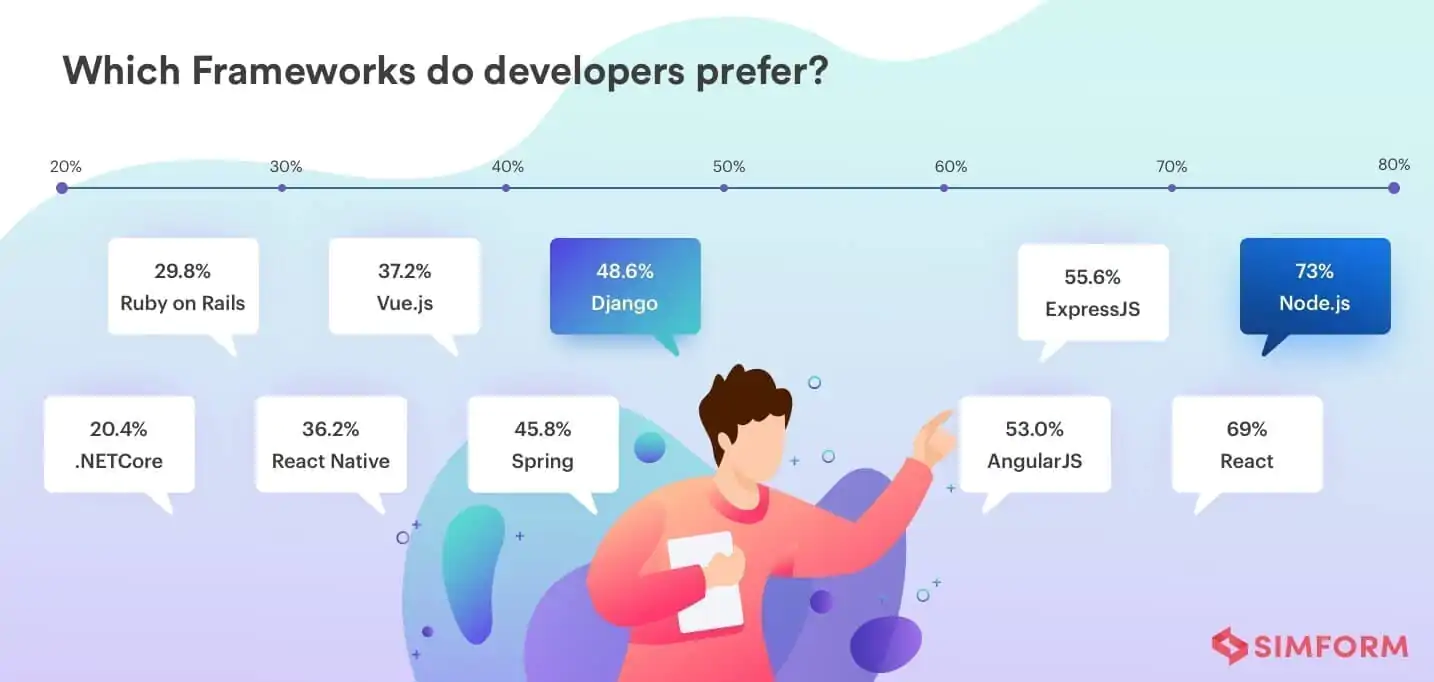
As per Stack Overflow 2022 survey, Python was one of the most ‘loved’ programming languages while Node.js was the most preferred tool among professional programmers.
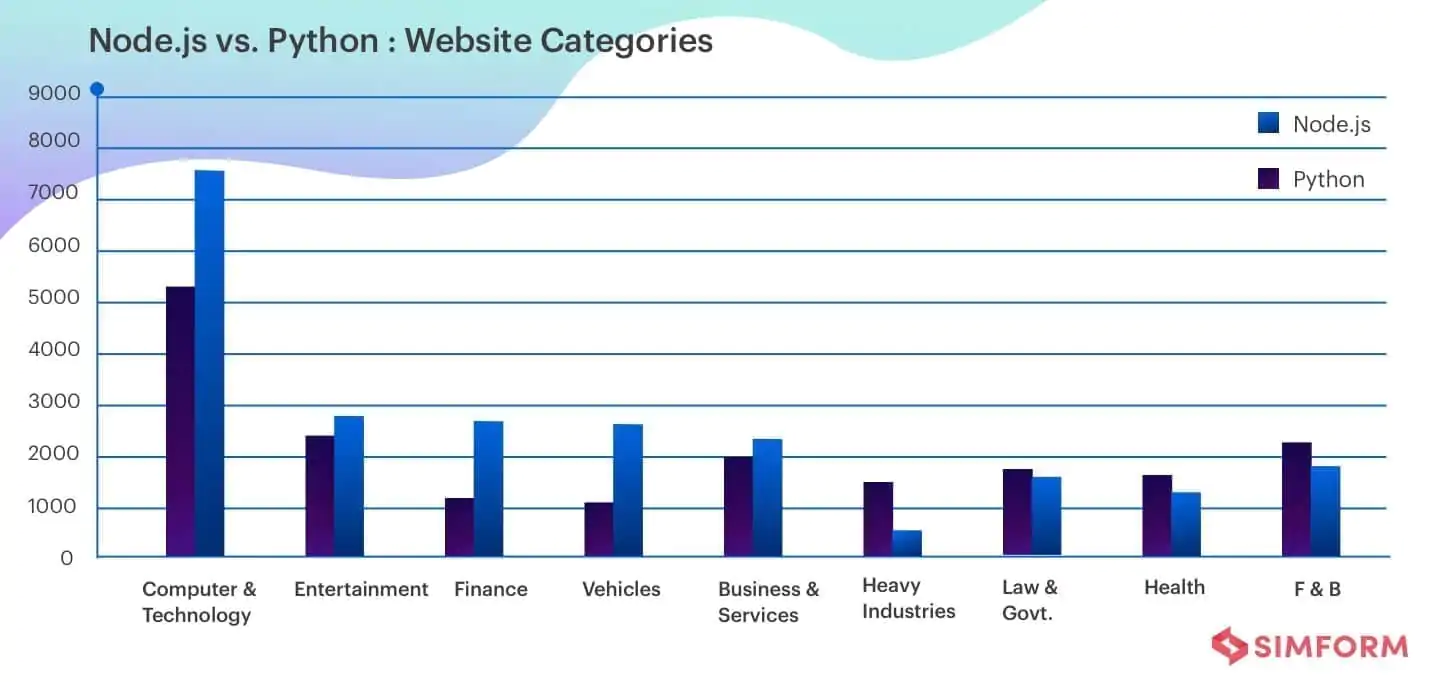
Reviewing industry-wise adoptions, Node.js has been leading in Computers Electronics & Technology, Lifestyle, Arts & Entertainment, and 16 other categories according to the survey. Whereas, Python is a popular choice in industries like Science & Education, Engineering, and several others.
Node.js vs Python: Detailed Comparison
#1 Scalability in Node.js vs Python
Scalability is the linear growth in resource requirements as you scale your web application. Initially, when you create an MVP, you will have a light web application and practically any language/coding environment will work for the task.
However, as you scale the application with features and functionalities, the resource consumption of the language/coding environment would also grow by the same proportion.
Node.js
Node.js gives you enough flexibility to avoid a core. This way, instead of creating a core and then scaling everything around it, you create a set of microservices and modules. When your application is scaled, these microservices and modules can dynamically run their own processes. Hence, you can scale the app horizontally by adding nodes to the existing ones and you can expand it vertically by adding resources.
Today’s best quote:
Node.js is designed for building distributed applications with many nodes. This is why it’s named Node.js. Scalability is baked into the platform and it’s not something you start thinking about later in the lifetime of an application.
— Andy Chen (@amazingandyyyer) April 2, 2018
Python
Python has issues with threads. It’s built on the Global Interpreter Lock, which does not allow it to operate several threads at once. This means that you cannot run another process before the sequentially historical process is over.
Although Python is dynamically typed, it’s more of a drawback in terms of scaling. Larger teams can find it difficult to maintain code when the project scales.
Simform Recommends:
Given the flexibility and low maintenance, Node.js is definitely more scalable than Python.

#2 Learning curve & Syntax in Node.js vs Python
‘Syntax’ refers to the efficiency of a language/programming environment to perform a set of functions with as few lines of code as possible. This is achieved by packing popular operations into inbuilt functions. It’s not difficult to assess how this relates to the learning curve concerning the language – the easier the syntax, the flatter the learning curve.
Node.js
The learning curve for Node.js is not that steep if you are already familiar with Javascript. Some people believe that its installation and documentation is a little tricky because of Node.js’ event-driven programming concept. This concept is the key reason why Node.js is scalable and efficient.
However, if you are a new developer, you might need some time to totally conceptualize event-driven programming. But once that’s taken care of, there is practically no hurdle in learning Node.js.
Python
Python’s USP has been its universality and easy syntax. It is an industry-wide fact that the length of code is relatively smaller in Python when compared to Node.js or other programming languages and runtime environments. Writing code in Python is just very simple.
Simform Recommends:
One key issue with both languages is that they are sensitive to indentation and whitespace. As a new developer, you might be making these two errors frequently, and it can become quite difficult to resolve such errors.
Both languages are easy to adopt. But depending upon what you already know, one would be easier than the other.
If you are familiar with Javascript, going for Node.js is a no-brainer. If you are new to programming, Python will discipline you at indentation and whitespaces but also give you enough room to make applications using its easier syntax. So let your requirement make the choice for you!
#3 Architecture in Node.js vs Python
Architecture defines the common practice/principles to adhere to the framework/environment or language. Nodejs has a single-threaded architecture, handling multiple requests with a single thread. In contrast, Python follows a standard implementation called “cpython” using the interchangeable code modules.
Node.js
As we observed earlier, Node.js is a runtime environment with server-side asynchronous programming. This means that the input-output functionality is not blocked because a certain process is still underway.
You can run parallel processes – deploying the application faster. Its event-driven architecture allows Node.js to take up actions as and when an event occurs.
Python
In stark contrast to Node.js, Python doesn’t provide such functionalities and doesn’t support multithreading. You have to run and finish one process before others can be called in. This makes Python a little stringent.
Although there are some tools that can help you create asynchronous apps using Python, they don’t make Python inherently asynchronous. You would end up using workarounds in the project and not actually get the desired asynchronicity.
Simform Recommends:
Thanks to its more receptive and conducive architecture, this round goes to Node.js.
#4 Performance & Speed in Node.js vs Python
When you are scaling an application, every single bit of efficiency helps reduce the operating costs. Hence, performance and speed are considered important while assessing a programming language or environment.
Node.js
We have already explored Node.js non-blocking architecture. With this edge, its execution process is simpler and faster. On top of this, there is still one more perk which makes Node.js a solid contender – it executes the code outside of the web browser.
This way, the app which is running on the web-browser is processing at a faster speed and performs better on the efficiency metrics as a result. This also allows the app to pull features such as TCP sockets, which are otherwise not available in the browsers.
Python
Python’s innate architecture prohibits multithreading and is a problem in this aspect as well. It slows down the processing speed as processes don’t run parallelly. While Python’s syntax is easy to learn and execute, it is not fast enough for applications that frequently recall data from the web server.
Simform Recommends:
Once you look at the performance differences between PHP, Python and Node.js, you will know why the future is Node.js #nodejs
— OPPORTUNITIES (@opportunities) May 15, 2015
Python’s syntax is easy to learn, but it’s not optimized for speed and performance. Node.js is the clear winner here too.
#5 Libraries & Dev Tools in Node.js vs Python
Libraries are the reason why the app-development technology has grown so much in the last few decades. The concept is simple – if something has been already devised as a code, you shouldn’t have to recreate it. Instead, you should be able to integrate this code directly from a library in your program while only writing code for the features that you want to create.
However, just the size or width of these libraries is not enough. You’d better also look into the documentation available to fully utilize the library of a language.
Node.js
Node.js actually has comprehensive and well-documented libraries managed by the Node Package Manager. With 350,000 packages, NPM is the largest repository of packages in the world.
Python
Python’s libraries are managed by Pip – an acronym for ‘Pip Installs Packages’. It’s an industry-observed fact that Python libraries are well-documented and easy to deploy. Although this is largely true, it isn’t the case for new libraries. New technologies are often not as well-documented as older ones- making the newer libraries a little less reliable.
Simform Recommends:
As far as libraries and ancillary-development tools are concerned, you will get plenty of options to choose from with both the technologies. Both work just as well!
#6 Community in Node.js vs Python

A community is a group of users and developers engaging with the technology. Since they are active, they would keep updating the popular libraries, run debugging exercises, and even add new features. Generally, the most effective communities are the ones that are managed by a singular, dedicated organization for the language/programming environment.
Node.js’ Community
You may look at Node.js as a relatively newer form of technology and might presume its community to be small. However, you’d be surprised to learn that Node.js community is quite large and globally active with experienced Node.js Developers. It’s super easy to discover talent in the Node.js circles.
Python’s Community
Python, being the older language of the two, naturally has a larger community. From junior to senior-level contributors, Python doesn’t have a dearth of talent. One of the biggest advantages of such a sizable community is the ease to find developers. And active participation from these developers results in swift solutions and overall improvement of the language.
Simform Recommends:
Both languages are growing and have global contributions made to their tech stacks. They are open-source and free to use. Hence, choosing one over the other just for the sake of availability of talent and community support shouldn’t factor into your decision.
#7 Extensibility in Node.js vs Python
The degree to which you can add features to a language using third-party tools is its extensibility. More extensibility across third-party tools would simply mean that the language can be modified with added features. Hence, it is crucial to look at this aspect while considering Node.js or Python.
Node.js
If you’re using its older versions, Node.js can be paired with Babel for smoother front-end development. You can also use Jasmine for unit-based testing or Log.io to manage the project. Webpack and PM2 can help you with module bundling whereas Express is one of the common frameworks used with Node.js.
Python
Sublime Text is often used with Python to edit codes. Robot Framework helps in automated testing. And then there are popular Nodejs frameworks like Django and Web2Py, which add a boatload of features.
Simform Recommends:
So, on a relative scale, both Node.js and Python have great extensibility with a bunch of frameworks and tools available to help you extend their functionalities.
#8 Universality in Node.js vs Python
Today, a web application can be accessed via as many devices as there are fingers on a hand. With such diverse avenues, it’s only natural that the development language/environment should be just as sophisticated.
Node.js
Node.js performs very well on this front since it’s usable for both backend and frontend development thanks to Javascript. Be it websites, web applications, desktop applications, mobile applications, or cloud & IoT solutions – Node.js is an allrounder!
Python
Python’s simpler syntax makes it apt for all forms of project except one – mobile apps. For IoT solutions and cloud apps, Python is being used more and more by a large number of programmers.
Simform Recommends:
Both technologies are platform independent, so they can be deployed for projects that have Mac, Linux, or Windows users.
#9 Error Handling Capabilities in Node.js vs Python
There’s nothing quite so satisfying as an error free code is. Hence, the language which has the best error-handling processes is always the go-to choice for CTOs.
Node.js
Node.js’ parallel-process running feature can make finding bugs and errors in the code a tedious process.
Python’s
Python’s simpler syntax and lack of parallel processes come in handy while scanning the code for bugs and errors.
Simform Recommends:
If handling of errors is a key metric in your decision, then you may have already concluded accurately that Python has a significant edge over Node.js.
#10 Data Processing in Node.js vs Python
This may seem insignificant aspect, but it deserves due consideration. Better data-processing power automatically makes a language/environment more efficient and adoptable.
Node.js
If the use case of your app is data intensive, your go-to choice should be Node.js. The technology offered by the runtime environment makes it ideal for apps where data is transmitted and handled quite frequently. The parallel running and seamless I/O operations make Node.js the more efficient contender here.
Python
With a simple syntax and only one thread running at a time, Python is relatively slow at processing data.
Simform Recommends:
Given its resource efficiency, Node.js is superior in this regard.
When to use Node.js over Python: Use Cases
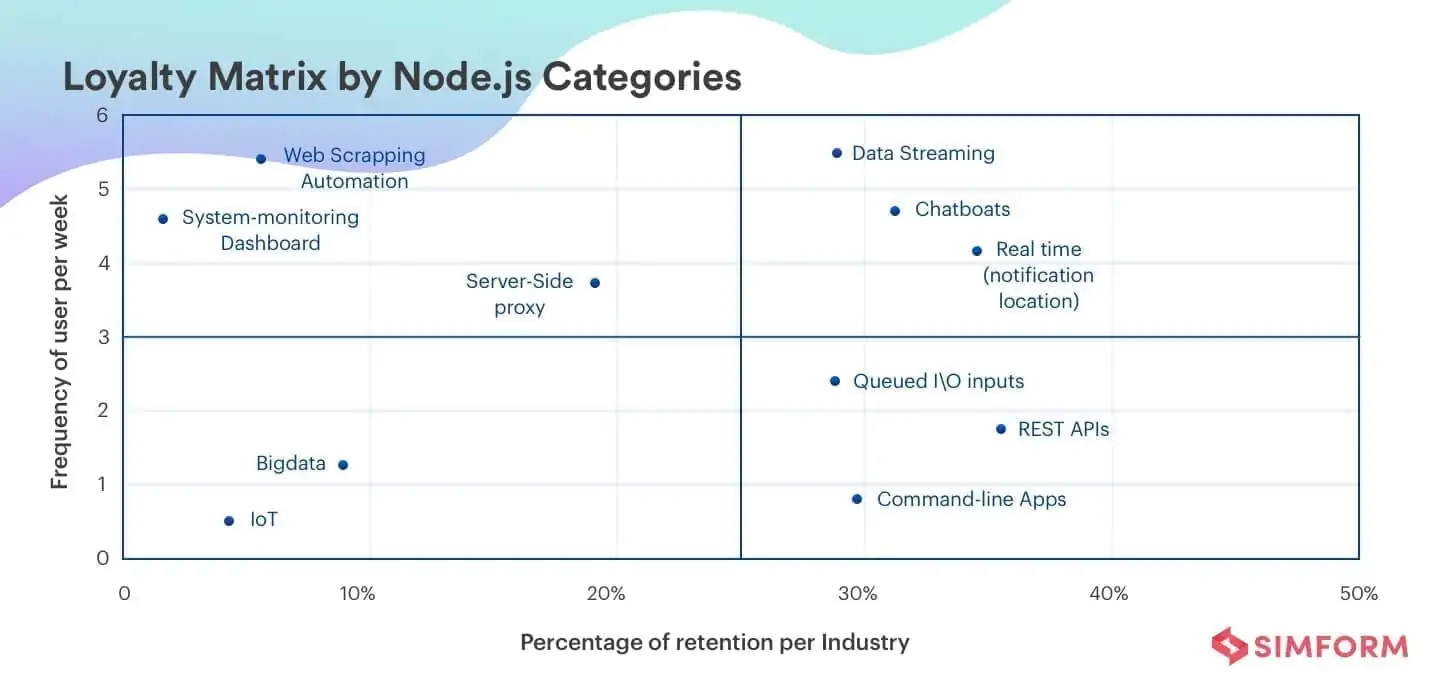
Node.js is the runtime environment that is ideal for applications that require a consistent connection between the server and the browser-side app. For instance, take a chatbot – if it is not seamlessly connected with the server, it will not be able to perform server operations to respond to customer queries.
An easy way to think about the need for Node.js in an application is by ranking the real-time feature for the app. If real-time data transmission is critical to the app’s usability, Node.js is exactly what you need.
It’s also noteworthy that Node.js can be used between both the server and client side. This will reduce the deployment time and make it feasible for teams to maintain the code while they coordinate.
Owing to its efficient processing, Node.js is the go-to platform used by companies that have frequent interactions between the cloud server and the client-side application. Netflix, LinkedIn, Medium, Trello, and Paypal are some well-known tech companies which use Node.js for their platform.
When to use Python over Node.js: Use Cases
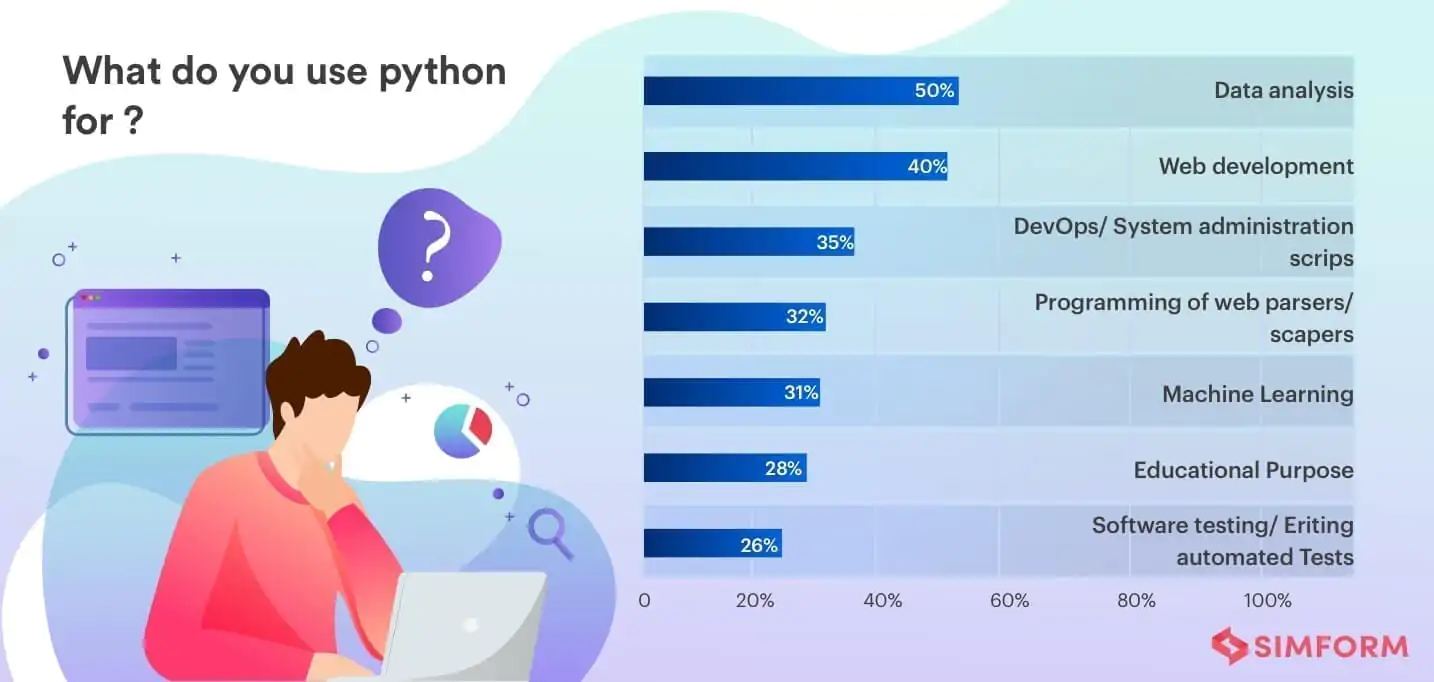
Python has an extensive availability of talent partly because it runs on an uncomplicated syntax. So there’s no surprise that Google and Facebook, two of the largest technology-talent consumers, extensively use Python to build technologies.
Moreover, some of the most popular data-science training courses use Python as the default language taught to students. As a result, the availability of Python talent is increasing.
Further, Python’s popularity makes it a strategically important language to learn and use. Its rich libraries allow you to build and deploy an MVP very efficiently. This also ensures that developer resources are optimally utilized.
For example, Reddit was originally written in Lisp, but the entire platform was rewritten with Python in 2005 thanks to its extensive list of features and libraries.
There’s more! The Python interpreter- responsible to execute the code- is super effective. It doesn’t need compilation, and this makes Python the ideal language for rapid deployment and iterations.
Conclusion
Choosing between Node.js and Python can be tricky especially when you want to develop a full-flagged product and not just a side-project. The features and benefits on both sides can be overwhelming and can cloud your judgement.
This is why, the ideal way to deal with this dilemma is by focusing on the end use of your product. List out all the features of your product, and how you plan to engineer them. And the language or runtime environment that proves more handy should be your pick.
And if you find yourself still perplexed or wonder if you made the right call, feel free to send your queries my way on tejas@simformlabs.com. It’d be my pleasure to understand your project and offer suggestions.
Which is faster? Node.js or Python?
Node.js is asynchronous; hence, it’s faster. Python does not allow multithreading, so it’s slower.
Is Python or Javascript more useful?
That depends on the use case you have for your application. Both languages have their standalone benefits.
Can you use Node.js with Python?
With some tools and workarounds, it is possible to use them together. However, it’s recommended that Node.js be used with Javascript.
Node.js vs Python – which is better for the backend?
Python is recommended for backend development. However, you could use Node.js both for backend as well as frontend development.
Python vs Node.js – which is better for web development?
Node.js is a better alternative for web development.


Duncan Rodger
Hi Tejas, I just read your article, and thank you for a great read. Just to mention the opening line says Node.js vs Python are two of the most compared backend technologies on the web -- the first is older and more established while the latter is up and coming. You then state that Python has been around since 1991, that would be the latter not the first. Cheers
Tejas
Hi Duncan, Thanks for reading and pointing out the error. We have updated it.