Downloaded by 150+ CTOs and engineering leaders
from enterprises globally
What’s inside the eBook
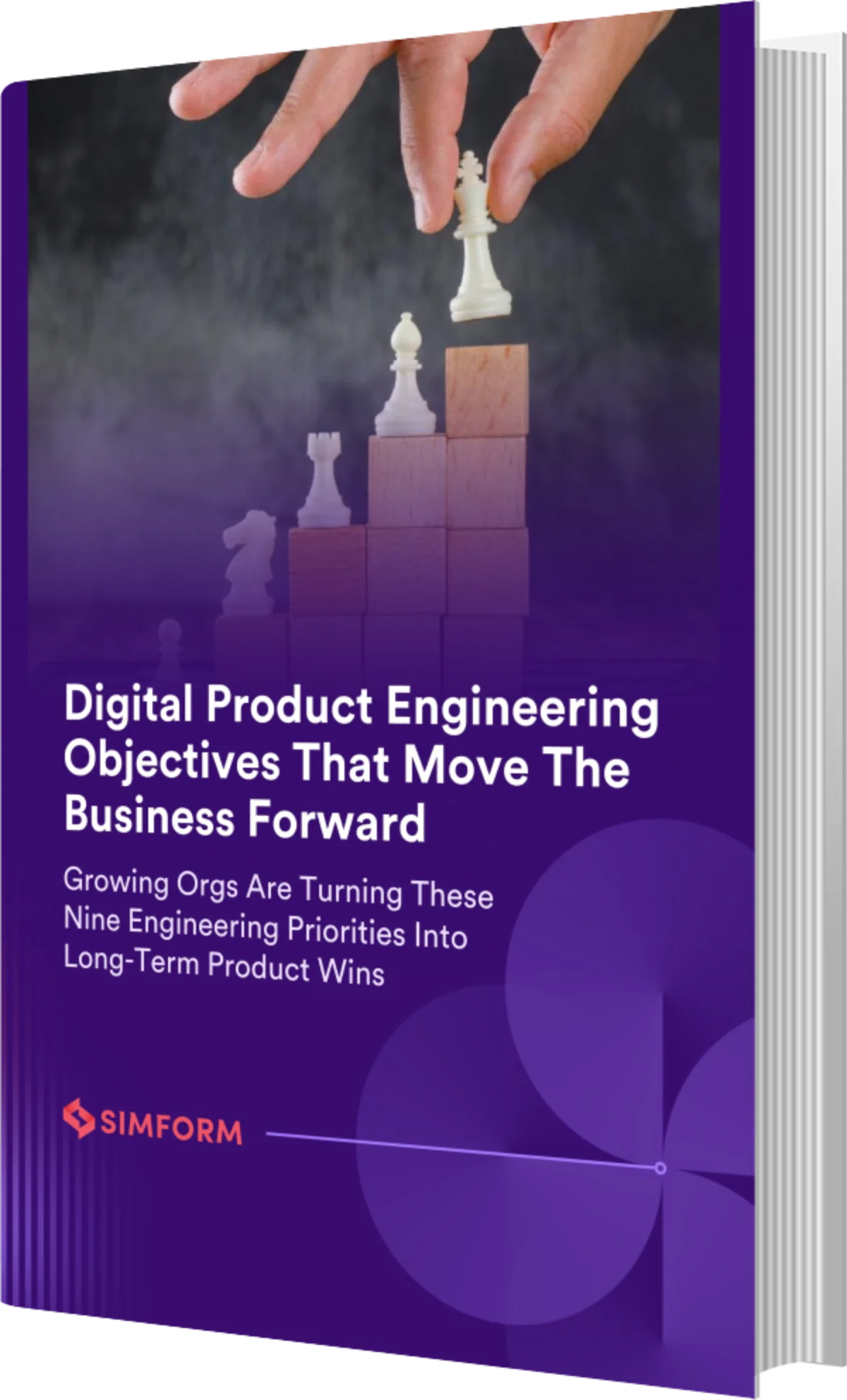
Today, Digital Product Engineering (DPE) is more than just code. It’s ensuring that engineering decisions consistently drive speed, scale, reliability, and business value. Too often, modernization efforts stall or AI pilots fail to scale, while teams get stuck balancing innovation with cost and compliance. This eBook distills Simform’s experience into a clear, 9-objectives approach to DPE: a structured way for decision-makers to align engineering with board-level goals.
Actionable engineering objectives
Assess your current engineering maturity against 9 proven objectives, uncover capability gaps, and apply step-by-step methods to prioritize and execute high-impact initiatives.
Engineering-business alignment
Learn how to translate architecture, platform, or data decisions into measurable outcomes like faster go-to-market, improved customer retention, and optimized cost efficiency.
Engineering progression model
Follow a clear progression model to evolve from tactical, ad-hoc improvements to a disciplined, scalable engineering function that supports continuous innovation.
Proven trade-off frameworks
Use ready-to-apply frameworks to balance speed vs. stability, cost vs. performance, and innovation vs. compliance, so you can make smarter decisions without second-guessing.
Guidance on emerging capabilities
Gain clarity on when and how to adopt AI/ML, data platforms, and platform engineering, and ensure these investments deliver business results rather than stalled pilots.
Lessons from real-world examples
See how leading organizations have applied these approaches to modernize legacy products, reduce downtime, and scale globally without sacrificing reliability.
3 reasons to read this eBook
This eBook is designed for CTOs, product heads, and IT leaders who require more than just high-level trends. It offers a strategic blueprint that translates engineering practices into outcomes executives care about: faster innovation cycles, lower costs, higher resilience, and readiness for the future.

Reduced cost of missteps
Avoid wasted spend on failed pilots or low-impact initiatives by applying methods that have been validated across real-world transformations.

Accelerated outcomes
Move from strategy to execution faster and smarter by applying structured objectives that keep teams focused on what matters most.

Engineer agility at scale
Embed best practices and proven frameworks that let teams move quickly without sacrificing reliability or compliance in a fast-changing market.
Recognized by Microsoft to Accelerate your Engineering Vision